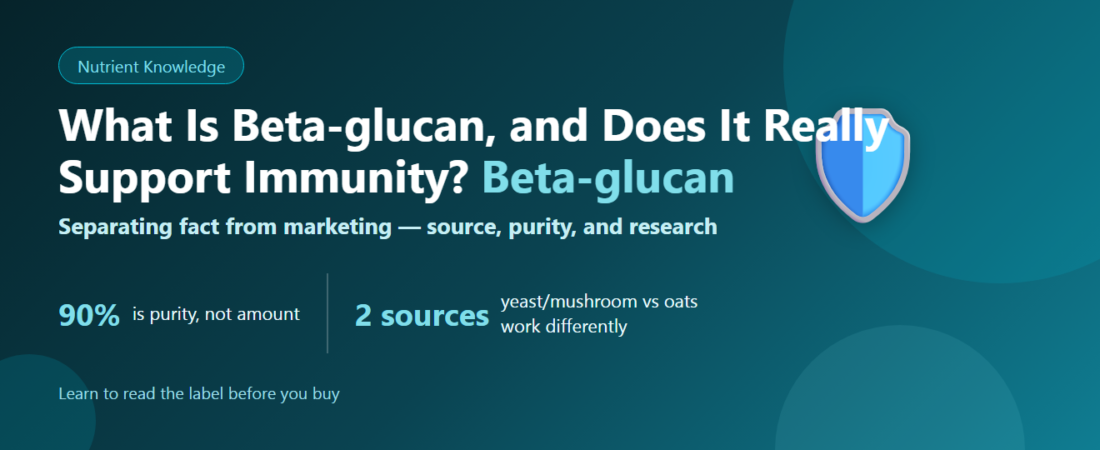
You see “beta-glucan 90%” plastered all over immune-support supplement labels · some people think it’s a weight-loss fiber, others think it’s a vitamin · and what does the number “90%” actually mean? Does it really support immunity, or is it just marketing? — Beta-glucan is a substance with a fair amount of real research behind it, but there are details sellers usually don’t tell you.
weight-loss fiber
work in different ways
check milligrams too
Beta-glucan is a special dietary fiber (a polysaccharide) found in the cell walls of yeast, mushrooms, and certain grains — and what many people don’t realize is that beta-glucan from different sources works in different ways. This article covers everything you should know — what beta-glucan is, how each source differs, what “90%” means, what the research says, and how to read a label properly.
1 What beta-glucan is — and what it isn’t
- It’s a special dietary fiber (a polysaccharide) — its structure is a chain of glucose sugars linked in a specific way
- It’s not a vitamin or mineral — it’s a complex carbohydrate
- It’s not an ordinary weight-loss fiber — although it is a dietary fiber, its strength lies in how it works with the immune system, not in making you feel full
- The body has specific “receptors” for it — immune cells have receptors that can bind to certain types of beta-glucan, which is the source of the interest in immunity
2 ⚠️ Different sources = they work differently (the point sellers rarely mention)
| Source | Structure | Strength |
|---|---|---|
| Yeast / mushroom (Beta-1,3/1,6-glucan) | Branched 1,3 and 1,6 chains | Immune side — the type that immune cells have receptors for · used in immune-support products |
| Oats / barley (Beta-1,3/1,4-glucan) | Straight 1,3 and 1,4 chains | Heart side — water-soluble, helps trap cholesterol in the gut · a different matter from immunity |
This is the single most important point: if you want to support immunity, it has to be beta-glucan from yeast or mushrooms (1,3/1,6) · whereas beta-glucan from oats (1,3/1,4) is notable for cholesterol — a different type, a different job · seeing the words “beta-glucan” alone isn’t enough; you need to check which source it comes from.
3 What “90%” means — and what the research says
“Beta-glucan 90%” = purity, not amount: this number tells you the extract is 90% pure beta-glucan (the other 10% is other parts of the cell wall) — the higher the purity the better, because you get a more concentrated active ingredient · but you have to look at it together with the amount (milligrams per day) — 90% beta-glucan added in a very small quantity still gives you little actual substance.
Which areas the research supports:
- Immunity — beta-glucan from yeast/mushrooms has research on modulating the function of immune cells, plus some studies on upper respiratory tract infections · but the studies vary in size and are not yet conclusive
- Cholesterol (only from oats) — there is fairly clear evidence that soluble beta-glucan helps slightly reduce LDL, to the point of having an approved health claim in some countries
⚠️ Note: dietary supplements are “supportive helpers” for health, not medicine; they do not prevent, treat, or cure disease · beta-glucan is not an immune-boosting drug that prevents infection, nor is it a lipid-lowering drug.
4 Read a beta-glucan label properly — check 4 things
- Which source it comes from — yeast/mushroom (immunity) or oats (cholesterol) · it must match what you want
- What % purity — 90% or above is considered concentrated
- How many mg per day — a high % but a small amount still gives you little actual substance · look at both
- It has an FDA number and a trustworthy manufacturer — always alongside the information above
💡 Did you know? Beta-glucan for immunity has to be the type from yeast/mushrooms (1,3/1,6) and of high purity · BLB U uses beta-glucan from yeast at 90% purity together with 4 kinds of mushrooms (natural beta-glucan sources), cordyceps, Korean ginseng, and CoQ10 — the idea is to have the immune-support and nourishing groups work together across 13 extracts · it’s a holistic health-care helper, not a drug that prevents infection.
5 Frequently Asked Questions (FAQ)
Does beta-glucan really boost immunity?
Beta-glucan from yeast/mushrooms has research on modulating the function of immune cells, but it’s not yet conclusive and it’s not a drug that prevents infection · it’s a supportive helper. Sleep, diet, and hand-washing still matter more for immunity.
Is beta-glucan the same as weight-loss fiber?
No, it isn’t · although beta-glucan is a dietary fiber, the type used for immune support (yeast/mushroom) focuses on working with the immune system, not on making you feel full or losing weight.
Is a higher “90%” always better?
High purity means a concentrated substance, which is good · but you have to look at the amount (mg) too, because 90% added in a very small quantity still gives you little actual substance. Consider both purity and amount.
Does beta-glucan from oats help immunity?
It’s notable in a different area · beta-glucan from oats (1,3/1,4) is notable for helping reduce cholesterol, not immunity · if you want to support immunity, you should choose the type from yeast/mushrooms.
Who should be careful taking beta-glucan?
People taking immunosuppressant drugs, or with an autoimmune disease, should consult a doctor first, because beta-glucan may modulate immune function.
Will taking beta-glucan mean I never get sick?
No · nothing makes you never get sick · beta-glucan is one supportive helper · immunity depends on many factors including sleep, stress, and overall diet.
6 Precautions
- People taking immunosuppressant drugs, or with an autoimmune disease, should consult a doctor first, because beta-glucan may modulate immune function
- Beta-glucan is not a drug that prevents infection; don’t use it in place of basic care or vaccines
- Read the full label — source, purity, and amount all need to be checked, not just the word “beta-glucan”
- Dietary supplements are not medicine; they do not prevent, treat, or cure disease; they are only health-care helpers
- Pregnant or breastfeeding women, or those on regular medication, should consult a doctor first · those allergic to yeast/mushrooms should read the label
7 Summary
- Beta-glucan is a special dietary fiber, not a vitamin and not a weight-loss fiber
- Different sources work in different ways — yeast/mushroom (immunity) vs oats (cholesterol)
- “90%” is purity, not amount — you have to check the milligrams too
- There is real research in some areas — but it’s not a drug that prevents infection
Beta-glucan is a genuinely valuable substance, but the details matter a lot — know which area you want to support, choose the matching source, look at both purity and amount, and you won’t be paying for the word “beta-glucan” floating vaguely on a label.
References
- Vetvicka V, et al. Beta Glucan: Supplement or Drug? From Laboratory to Clinical Trials. Molecules.
- EFSA Panel — Scientific Opinion on oat beta-glucan and blood cholesterol.
- NIH Office of Dietary Supplements / Memorial Sloan Kettering — Beta-glucan: About Herbs.
- Geller A, Yan J. The Role of Membrane Bound Complement Regulatory Proteins & β-glucan in immunity. Front Immunol.
💡 Looking for a supportive helper? Read on: Immune-boosting supplements — which brand is good, and how to choose wisely 👉