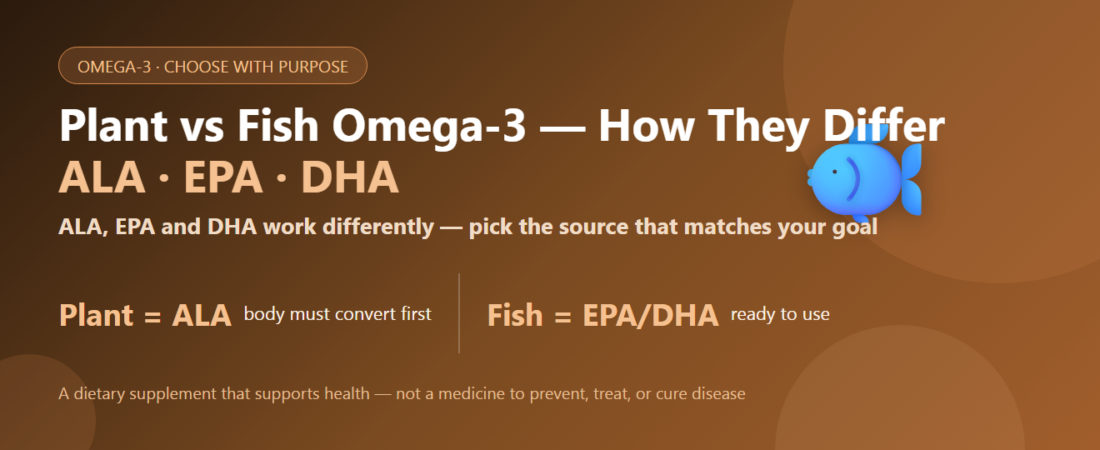
Omega-3 is good for the heart and brain — many people already know that · but what fewer people know is that omega-3 from “plants” and from “fish” are not the same, and the body uses them differently · If you eat flaxseed hoping for the same effect as fish oil, you may be disappointed if you don’t understand this point · This article explains the difference between ALA · EPA · DHA in simple terms, and helps you choose the source that matches your goal
work differently
convert first
no conversion needed
“Omega-3” isn’t a single substance — it’s a group of beneficial fatty acids with 3 important types — and their differences are the heart of this article · Once you understand it, you can choose a source that truly matches what you need, without spending on the wrong thing
1 ALA · EPA · DHA — 3 Types You Need to Tell Apart
| Type | Source | How the Body Uses It |
|---|---|---|
| ALA (Alpha-Linolenic Acid) | Plants — flaxseed, Sacha Inchi, perilla seed, walnuts | The “starting material” · the body must convert it into EPA/DHA before use, but conversion is low |
| EPA (Eicosapentaenoic Acid) | Deep-sea fish · algae | Ready to use · notable for inflammation/heart health |
| DHA (Docosahexaenoic Acid) | Fish · algae | Ready to use · notable for brain/eye health |
Most important point: Plant-based omega-3 is ALA, which the body can only convert into EPA/DHA in small amounts (research estimates conversion to EPA at around 5-10%, and conversion to DHA is far lower) · Fish-based omega-3, on the other hand, is EPA/DHA that is ready to use immediately
2 So Is Plant Omega-3 Worse Than Fish? — No, They Just Play Different Roles
- Plant-based omega-3 (ALA) — still has its own benefits; it’s an essential fatty acid the body cannot make on its own · suitable for vegetarians/those who don’t eat fish · often comes together with other plant compounds, such as antioxidants
- Fish-based omega-3 (EPA/DHA) — provides a ready-to-use form, good if you want EPA/DHA directly · but you need to be mindful of the fish source and heavy-metal contamination
- Algae — a direct plant-based source of EPA/DHA (fish also get their EPA/DHA from algae) · suitable for vegetarians who want EPA/DHA
In short: it’s not that plants lose to fish — they simply serve different purposes — choose based on what you need and how you eat
3 What Does Research Say
- Heart/blood lipids — EPA/DHA have research supporting help in lowering triglycerides · ALA also has studies linking it to heart health, but the evidence is weaker
- Brain/eyes — DHA is a structural component of the brain and retina
- Inflammation — omega-3 overall is linked to helping balance inflammation in the body
⚠️ Dietary supplements are a supportive aid, not a medicine · They have no effect in preventing, treating, or curing disease · Omega-3 is not a medicine for heart disease or a lipid-lowering drug — heart care requires an overall balanced diet, exercise, and medical advice
4 Choosing the Right Omega-3 for Your Goal
- Already eating sea fish 2-3 meals/week? — you may already get enough EPA/DHA from food
- Don’t eat fish/vegetarian? — consider plant-based omega-3 (ALA) or algae-based (EPA/DHA)
- Check the actual EPA+DHA amount — in fish oil products, what matters is the mg of EPA+DHA, not just “1000mg fish oil”
- For plant sources, check the oil type — such as Sacha Inchi oil, perilla oil, or flaxseed, which provide ALA
💡 Did you know? BLB P is a formula of cold-pressed oil from 8 plant types that combines plant-based omega-3 sources (ALA) such as Sacha Inchi, flaxseed, perilla seed together with rice bran oil, olive oil, and CoQ10 — suitable for those who want plant-based healthy fats to support heart and blood vessel care · It is a health-supportive aid, not a medicine for heart disease
5 Frequently Asked Questions (FAQ)
Which is better, plant-based or fish-based omega-3?
They play different roles, not better or worse · Plants provide ALA, which the body must convert further (with low conversion) · Fish provides EPA/DHA, ready to use directly · Choose based on whether you eat fish and what you need
Can I eat flaxseed instead of fish oil?
You’ll get ALA, but the body converts it to EPA/DHA in only small amounts · If you want EPA/DHA directly, flaxseed alone may not be enough · A vegetarian option that provides EPA/DHA is algae oil
Can omega-3 really help lower blood lipids?
EPA/DHA have research supporting help in lowering triglycerides · but it is not a lipid-lowering medicine and does not replace overall dietary care and medical advice · Those with high lipids should consult a doctor
Does 1000 mg of fish oil mean 1000 mg of omega-3?
No · “1000mg fish oil” refers to the total oil amount · You need to check how many mg of actual EPA+DHA it contains, which is usually much less · Read the label carefully
Who should be cautious about supplementing with omega-3?
Those taking blood-thinning medication, or before surgery, should consult a doctor because high-dose omega-3 may affect blood clotting
When should I take omega-3?
Generally, take it with a meal that contains fat to help absorption · Consistency matters more than timing
6 Precautions
- Those taking blood-thinning medication (such as warfarin), or before surgery, should consult a doctor first
- Omega-3 is not a medicine for heart disease or a lipid-lowering drug — those with lipid issues/blood pressure/heart disease must remain under medical care
- Choose fish oil sources that have been tested for heavy metals · for plant sources, clearly check the oil type
- Dietary supplements are not medicine — they have no effect in preventing, treating, or curing disease; they are merely a health-supportive aid
- Pregnant/breastfeeding women should consult a doctor about the type and amount
7 Summary
- Omega-3 has 3 main types — ALA (plant) · EPA · DHA (fish/algae)
- Plants provide ALA, which must be converted further (low conversion) · Fish provides EPA/DHA, ready to use directly
- It’s not that plants lose to fish — they simply serve different purposes — choose based on your diet and goals
- Check the actual EPA+DHA amount, not just the total fish oil number
Once you understand ALA · EPA · DHA, you can choose the omega-3 that truly matches your body and lifestyle — not just buy something because it says “omega-3” on the label
References
- NIH Office of Dietary Supplements — Omega-3 Fatty Acids Fact Sheet.
- Baker EJ, et al. Metabolism & functional effects of plant-derived omega-3 fatty acids. Progress in Lipid Research.
- AHA Science Advisory — Omega-3 Polyunsaturated Fatty Acids and Cardiovascular Health.
- Saini RK, Keum YS. Omega-3 and omega-6 PUFAs: Dietary sources, metabolism, and significance. Life Sciences.
💡 Looking for a supportive aid? Read more: Which Omega-3 Brand Is Good — Choose Wisely 👉