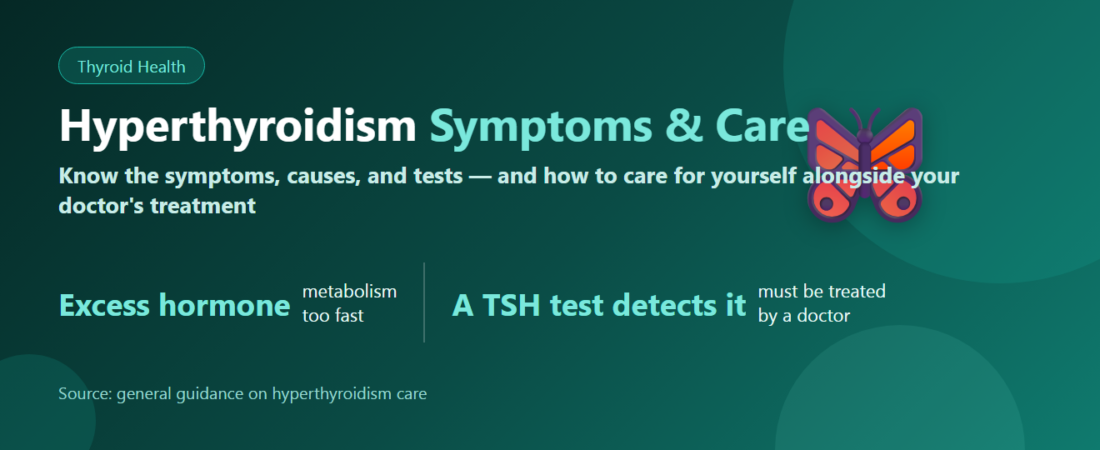
Palpitations, trembling hands, weight loss despite eating a lot, feeling hot, sweating easily, irritability, insomnia · Many people think these are just from stress or lack of rest · But sometimes they are a sign of hyperthyroidism (overactive thyroid), where the thyroid gland produces too much hormone · This article takes an in-depth look at the symptoms, causes, tests, and how to care for yourself alongside your doctor’s treatment.
too fast
heat intolerance
by a doctor
Hyperthyroidism is a condition in which the thyroid gland produces too much hormone, causing the body’s metabolism to run faster than normal · It is the opposite of hypothyroidism (too little hormone) · It must be diagnosed and treated by a doctor, because if left untreated it can affect the heart and the body.
1 Hyperthyroidism symptoms — how to spot them
- Palpitations, fast heartbeat — the most common prominent symptom
- Weight loss even while eating the same or more — because of fast metabolism
- Trembling hands, sweating easily, heat intolerance
- Irritability, restlessness, insomnia
- Fatigue, muscle weakness
- Bulging eyes, enlarged neck (goiter) in some cases
- Irregular menstruation in women
2 Causes of hyperthyroidism
| Cause | Details |
|---|---|
| Graves’ disease | An autoimmune disease that stimulates the thyroid gland — the most common cause |
| Thyroid nodules/lumps | Produce excess hormone on their own |
| Thyroiditis (thyroid inflammation) | Temporarily releases a large amount of hormone |
| Excess iodine intake | In some cases |
3 Testing and treatment — you must see a doctor
A blood test for TSH and thyroid hormones (Free T3/T4) is the main method · Treatment has several options depending on the cause and severity, such as antithyroid drugs, radioactive iodine therapy, or surgery, which the doctor will decide on.
⚠️ Very important: Hyperthyroidism must be treated by a doctor · If left untreated it can cause heart arrhythmia or severe hyperthyroidism (thyroid storm), which can be life-threatening · Dietary supplements cannot treat it, and you must never stop your medication on your own.
4 How to care for yourself (alongside your doctor’s treatment)
- Take your medication and keep your appointments regularly — monitor blood levels to adjust treatment
- Beware of excess iodine — such as large amounts of seafood or seaweed, as advised by your doctor
- Avoid excess caffeine — it may trigger palpitations
- Rest enough and manage stress — helps reduce symptom flare-ups
- Take care of your overall health — especially in Graves’ disease, which involves the immune system
💡 Holistic care: In cases of autoimmune hyperthyroidism (Graves’), caring for your immune balance and overall health is part of self-care · BLB U is a dietary supplement with 13 extracts focused on holistic immune support, which may be used as a supplementary aid alongside your doctor’s treatment · It is not a drug, does not replace thyroid medication, and has no effect in treating disease — you should consult your doctor before using it together with your regular medication.
5 Frequently Asked Questions (FAQ)
What is the difference between hyperthyroidism and hypothyroidism?
They are opposites · Hyperthyroidism = too much hormone (weight loss, palpitations, heat intolerance) · Hypothyroidism = too little hormone (easy weight gain, fatigue, feeling cold easily) · A blood test is needed to tell them apart.
Can hyperthyroidism be cured completely?
It depends on the cause · Some cases can be controlled with medication, some are treated with radioactive iodine or surgery · It must be under a doctor’s care with continuous follow-up.
Can supplements help with hyperthyroidism?
They cannot treat it and do not replace medication · Some (such as high iodine) may make it worse · You should consult your doctor before taking any supplement.
Should I worry about frequent palpitations?
Palpitations have many causes · If palpitations occur together with weight loss, trembling hands, and heat intolerance, you should see a doctor to check your thyroid and heart · Don’t ignore it.
Does stress cause hyperthyroidism?
Stress may be a trigger in some people, but it is not the main cause · Most cases are caused by autoimmune disease or a disorder of the gland.
Can I get pregnant if I have hyperthyroidism?
Yes, but you must be under close medical supervision, because it affects pregnancy and treatment must be adjusted and monitored closely.
6 Precautions
- Hyperthyroidism must be treated by a doctor; never stop your medication on your own — risk of serious complications
- Severe palpitations, chest pain, or difficulty breathing require urgent medical attention
- Beware of high iodine (seaweed/certain supplements) — it may worsen symptoms — consult your doctor
- Supplements are not a thyroid medication — they are only an aid for holistic health care
- Dietary supplements are not drugs — they have no effect in preventing, alleviating, or treating disease
7 Summary
- Hyperthyroidism = too much thyroid hormone, causing fast metabolism
- Prominent symptoms — palpitations, weight loss, trembling hands, heat intolerance, irritability, insomnia
- A TSH test detects it · It must be treated by a doctor (medication/radioactive iodine/surgery)
- Supplements are an aid for holistic care; they do not replace medication
Hyperthyroidism is a manageable condition when correctly diagnosed and treated continuously — don’t overlook palpitations and abnormal weight loss, and don’t self-treat · Seeing a doctor for a blood test is the right place to start.
References
- American Thyroid Association — Hyperthyroidism (Overactive Thyroid).
- NIDDK — Hyperthyroidism (Overactive Thyroid).
- Royal College of Physicians of Thailand — Guidelines for managing hyperthyroidism.
- Ross DS, et al. ATA Guidelines for Diagnosis and Management of Hyperthyroidism. Thyroid.
💡 Looking for a supportive aid? Read more: Which Vitamin D Brand Is Best — Choose Wisely 👉