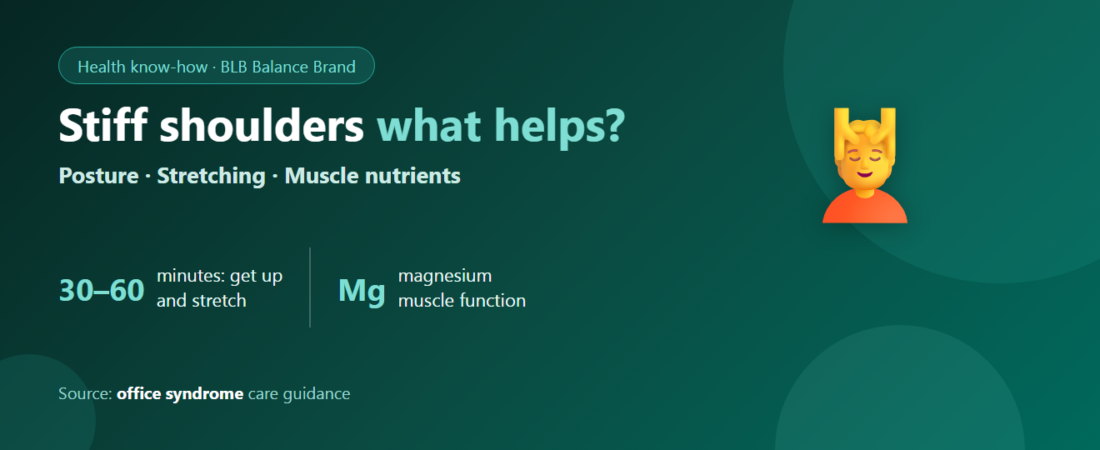
Stiff, aching shoulders and neck from sitting at work for long periods (so-called office syndrome) are a common problem for working people · This article summarises posture adjustments and stretching, along with nutrients involved in muscle function
muscles
Most stiff, aching shoulders come from holding a posture for a long time, muscle tension and stress · Tackling the root cause means adjusting how you sit, getting up to stretch and moving your body · Some nutrients, such as magnesium, are involved in muscle function and relaxation
1 Adjust your posture and move your body
- Set your screen at eye level, rest your arms comfortably, keep your feet on the floor
- Get up and stretch every 30–60 minutes — stretch your neck, upper back and shoulders
- Use a warm compress and exercise your back–core muscles
2 Nutrients related to muscles
- Magnesium — involved in muscle contraction and relaxation; a deficiency may be associated with cramps/tension
- Electrolytes — mineral balance affects the muscles
⚠️ It is a support for care — not a painkiller and not a treatment for office syndrome
3 How to choose a support
- A form of magnesium that absorbs well and is gentle on the stomach
- Take it alongside stretching and posture correction — supplements can’t help if your posture is still wrong
- Drink enough water and get enough rest
4 When to see a doctor
If you have pain radiating down the arm, numbness, weakness, severe pain at night, or chronic pain that won’t go away, see a doctor/physiotherapist, as there may be a spinal disc or nerve problem
5 Frequently asked questions (FAQ)
Does magnesium really help relax muscles?
Magnesium is involved in muscle function, and a deficiency may be associated with tension/cramps, but supplementing helps only when you are deficient, and it is not a painkiller
Can office syndrome go away?
It can improve a lot with posture correction, stretching and exercise, but you must do them consistently; supplements are only an add-on
Hot or cold compress — which is better?
Chronic stiffness and tension usually call for a warm compress, while acute injuries with swelling and inflammation call for a cold compress in the early stage
When should I take magnesium?
Many people choose the evening/before bed because they feel relaxed; choose a well-absorbed form to reduce loose stools
- Dietary supplements are not medicines — they have no effect in preventing, alleviating or treating disease; they are only a health-care support
- People with chronic conditions or on regular medication should consult a doctor/pharmacist before use, as there may be interactions
- Pregnant and breastfeeding women should consult a doctor first
- Pain radiating down the arm, numbness, weakness may be a nerve problem — see a doctor/physiotherapist
References
- General care guidance for postural muscle pain (office syndrome).
💡 Looking for some support? Read next: Muscle care & cramps — how to choose a support 👉