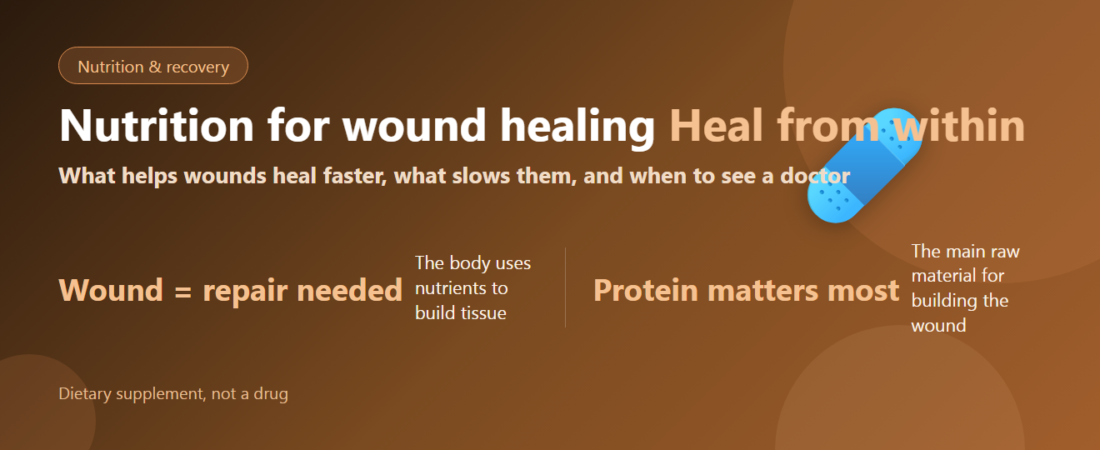
Surgical wounds, abrasions, or chronic wounds that “heal slower than they should” — often this doesn’t depend on wound care alone, but also on the nutrients the body uses to repair tissue · Wound healing is a process in which the body needs protein, vitamins, minerals, and a well-functioning immune system · What helps wounds heal faster, what makes them heal slower, and when you should see a doctor · This article explains it in an easy-to-understand way
nutrients to build tissue
for building the wound
see a doctor
Wound healing has 3 main phases — stopping bleeding/inflammation to clear germs, building new tissue, and remodeling for strength · Every phase needs nutrients as raw material and the immune system as the workforce · People who lack nutrients, have chronic conditions, or a weak immune system therefore often heal more slowly · This article is nutritional knowledge, not a treatment · Infected or abnormally slow-healing wounds must be seen by a doctor
1 Nutrients that help wounds heal faster
| Nutrient | Role in wound healing |
|---|---|
| Protein | The main raw material for building tissue and collagen — lacking protein makes wounds heal very slowly |
| Vitamin C | Essential for building collagen and fighting free radicals |
| Zinc | Involved in cell division and immunity — important for wound closure |
| Vitamin A | Involved in building epithelial tissue and immunity |
| Iron | Helps carry oxygen to the tissue being repaired |
| Water | Keeps tissue moist and transports nutrients |
These nutrients work together — eating a varied, complete diet to get them all matters more than focusing on any single one
2 What makes wounds heal slowly
- Diabetes / high blood sugar — a major cause of chronic wounds
- Nutrient deficiency, especially protein
- Poor blood circulation — less blood reaching the wound
- Smoking — clearly reduces blood supply to the wound
- Weak immunity · taking immunosuppressants/steroids
- Infected wound — swollen, red, hot, with pus
- Older age — the repair process naturally slows down
3 Caring for wounds to heal faster — the basics you can do
- Clean the wound as instructed by your doctor/nurse
- Eat enough protein — meat, eggs, fish, milk, beans, tofu
- Eat vegetables and fruit with vitamin C and a varied diet
- Manage chronic conditions, especially diabetes
- Don’t smoke · rest enough
- Drink enough water
💡 Slow-healing wounds may be related to blood sugar levels · People with high blood sugar or diabetes often have wounds that heal more slowly than usual, because high sugar affects blood circulation and tissue repair · Caring for the balance of blood sugar and blood lipids is therefore an important foundation · BLB P is a dietary supplement made from 9 kinds of natural oils (sacha inchi, flaxseed, rice bran, black sesame — sources of omega-3 and good fats) that focuses on caring for the balance of blood lipids and blood sugar (อย. 26-1-10867-5-0050) · Suitable for those who want to care for overall vascular health and blood sugar levels · It is a dietary supplement, not a drug, has no effect in preventing, treating, or curing disease, and does not directly make wounds heal faster · People with diabetes should care for wounds following their doctor’s advice
4 ⚠️ What kind of wound needs a doctor
See a doctor when: the wound is swollen, red, hot, has pus or odor (signs of infection) · the wound doesn’t improve at all within 1-2 weeks · wounds in people with diabetes (especially on the feet) · deep wounds, bleeding that won’t stop · fever together with a wound · chronic wounds that healed and came back — diabetic foot wounds must not be neglected, as they can progress severely
5 Frequently Asked Questions (FAQ)
Does eating lots of protein help wounds heal faster?
Sufficient protein is important for building tissue · but eating more than you need doesn’t make healing especially faster · getting enough consistently is better
Why do diabetic wounds heal slowly?
High sugar damages blood vessels and nerves, so less blood reaches the wound and you feel less pain and neglect it · people with diabetes should care for wounds closely and see a doctor early
Do supplements help wounds heal faster?
If you’re truly deficient, getting enough can help · but supplements are not drugs and don’t directly speed wound healing · eating a complete diet and caring for the wound properly matters more
Should I avoid any foods when I have a wound?
There are no specific forbidden foods for the general person · many “taboo food” beliefs have no evidence · what matters is eating a complete diet and controlling sugar if you have diabetes
Does vitamin C really help wounds heal?
Vitamin C is essential for building collagen · getting enough helps wound healing, but taking high doses beyond your needs doesn’t help more
6 Precautions
- Infected wounds (swelling, redness, pus, fever) or diabetic wounds must be seen by a doctor, don’t wait for them to heal on their own
- Don’t believe taboo-food myths that lead to an incomplete diet and nutrient deficiency
- Those taking immunosuppressants/steroids or with chronic conditions heal more slowly and should be cared for closely
- Dietary supplements are not drugs, they have no effect in preventing, treating, or curing disease, and do not directly make wounds heal faster
7 Summary
- Wound healing needs nutrients — protein, vitamin C, zinc, vitamin A, iron
- Culprits for slow healing — diabetes, nutrient deficiency, smoking, weak immunity, infection
- Care — proper wound care, eating protein/a complete diet, managing chronic conditions, not smoking
- Infected/diabetic/slow-healing wounds = see a doctor
Fast wound healing doesn’t depend on topical medicine alone, but also on caring for the body from within — eat completely, rest enough, manage chronic conditions, and know when you should see a doctor
References
- NIH / MedlinePlus — Wound healing and nutrition.
- Harvard Health — Nutrition for wound healing.
- American Diabetes Association — Diabetic wound care.
- Journal of Wound Care — Nutritional support in wound healing.