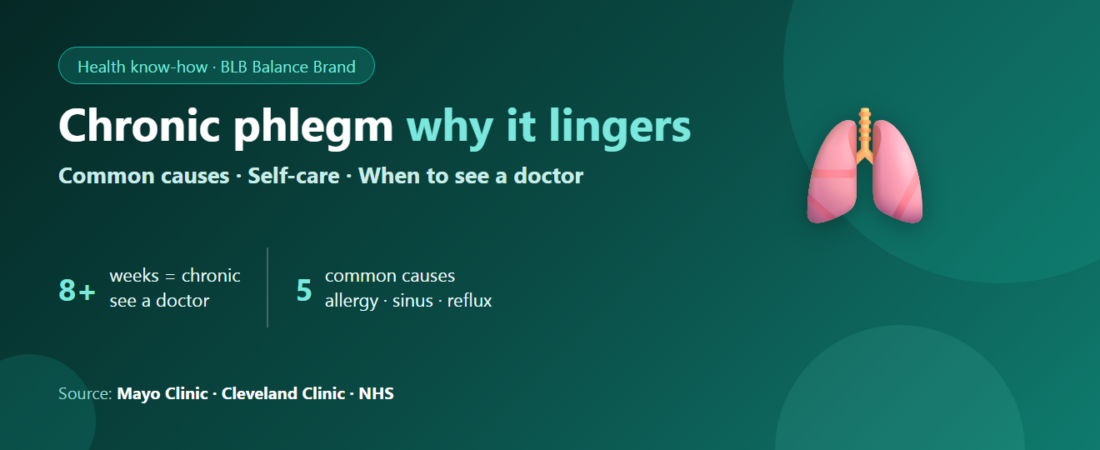
Feeling like phlegm is stuck in your throat all the time, having to clear your throat often, an irritated throat, a lump-like feeling when you swallow — “chronic phlegm in the throat” is bothersome and very common · Many people take phlegm-thinning medicine and it still doesn’t go away, because it can actually come from many causes · This article explains what causes chronic phlegm, how to take care of yourself, and when to see a doctor
Acid reflux
See a doctor
are a support for care
Phlegm (mucus/phlegm) is the slimy fluid the body makes to trap dust and germs and to keep the airways moist — that is normal · But when there is an abnormally large amount, when it is thick and sticky, or when it feels stuck in the throat for more than 8 weeks, it is often a sign that something is triggering it · This article provides knowledge for self-care; it is not for diagnosing or treating disease
1 What can cause chronic phlegm
| Common causes | Features often seen with it |
|---|---|
| Mucus running down the throat (Post-nasal drip) | From allergies/sinus problems · A feeling of mucus running down the throat, frequent throat clearing in the morning |
| Allergic rhinitis | Stuffy nose, sneezing, itchy eyes, coming and going with the triggers |
| Acid reflux (LPR) | Hoarse voice, irritated throat, dry cough, worse after meals/when lying down to sleep |
| Chronic bronchitis / smoking | Chronic cough with phlegm, especially in people who smoke |
| Dry air/pollution/drinking too little water | Thick, sticky phlegm, dry throat |
2 Basic self-care
- Drink enough water — helps thin the phlegm so it is easier to clear
- Avoid triggers — dust, cigarette smoke, very cold air, things you are allergic to
- Saline nasal rinse — helps reduce mucus dripping down the throat in people with allergies/sinus problems
- Change your habits if you suspect acid reflux — don’t eat a full meal before bed, avoid fried food/spicy food/coffee, sleep with your head elevated
- Inhale warm steam — helps keep the airways moist and loosens phlegm
- Stop smoking — it is a major cause of phlegm and chronic cough
3 When to see a doctor (important)
- Blood in the phlegm or green/dark yellow phlegm together with a fever
- Chronic phlegm lasting more than 3–8 weeks without improving
- Unexplained weight loss · Night sweats · Difficulty breathing
- Chronic hoarseness or difficulty swallowing
These symptoms must be checked by a doctor to find the cause — chronic phlegm is sometimes a sign of a disease that needs specific treatment. Don’t keep buying medicine and treating yourself for a long time without finding the cause
💡 Caring for your immune system and airways from within · People with chronic respiratory problems or frequent allergies often pay attention to building up their immunity alongside avoiding triggers · BLB U is a dietary supplement product focused on supporting the immune system and the body’s recovery, with 4 kinds of mushroom, beta-glucan 90%, cordyceps and Korean ginseng (Thai FDA 26-1-10867-5-0049) · It is a dietary supplement, not a medicine; it has no effect in preventing, alleviating or treating disease · It is not used to treat phlegm or respiratory disease · If your symptoms are chronic, see a doctor
4 Myths about phlegm
| Myth | Fact |
|---|---|
| “A lot of phlegm = you need antibiotics” | Most phlegm does not come from bacteria · Antibiotics don’t help, and using them indiscriminately is harmful · This must be decided by a doctor |
| “Drinking milk causes more phlegm” | Most research has not found that milk actually increases phlegm production · It may just feel like it coats the throat for a while |
| “Clearing your throat often helps get the phlegm out” | Clearing the throat hard and often irritates it and makes things worse · Sipping water or swallowing helps more |
5 Frequently asked questions (FAQ)
Phlegm stuck in my throat all the time, but no cough and no cold — what causes it?
It commonly comes from “mucus dripping down the throat” due to allergies or sinus problems, and from acid reflux · Watch for accompanying symptoms (stuffy nose, hoarse voice, a burning throat after meals), and if it is chronic, see an ENT doctor
Can dietary supplements help with chronic phlegm?
Dietary supplements are not a medicine for treating phlegm · The care that works is finding and managing the “cause” (allergies, sinus problems, acid reflux) · Immune support is only general health care; it does not treat the symptom directly
What colour of phlegm is dangerous?
Clear or white phlegm is usually not a concern · But if it has blood in it, or is green/dark yellow together with a fever or difficulty breathing, see a doctor
After how many weeks of chronic phlegm should I see a doctor?
In general, if phlegm or a chronic cough lasts more than 3–8 weeks without improving, or there are warning signs (blood in the phlegm, weight loss, difficulty breathing), see a doctor to find the cause
Does drinking warm water really help with phlegm?
It helps in the sense of thinning the phlegm and making it easier to clear, as well as reducing throat irritation · But it is relief; it does not fix the cause
6 Summary
- Chronic phlegm has many causes — allergies, sinus problems, acid reflux, bronchitis, dry air
- Take care of yourself — drink enough water, avoid triggers, rinse your nose, stop smoking, change habits for acid reflux
- If there are warning signs (blood in the phlegm, weight loss, long-lasting symptoms), you must see a doctor
- Dietary supplements are not medicines — they are a support for health care; they do not treat phlegm or disease
Chronic phlegm is not a disease, but a symptom telling you that something is triggering it — the key is to find the cause and deal with it at the source, while keeping your overall health strong
References
- Mayo Clinic — Chronic cough & postnasal drip.
- Cleveland Clinic — Phlegm and mucus.
- AAAAI (American Academy of Allergy, Asthma & Immunology) — Postnasal drip.
- NHS — Cough & chest infection self-care.
💡 Looking for some support? Read next: Immune supplements: which brand is best — how to choose well 👉