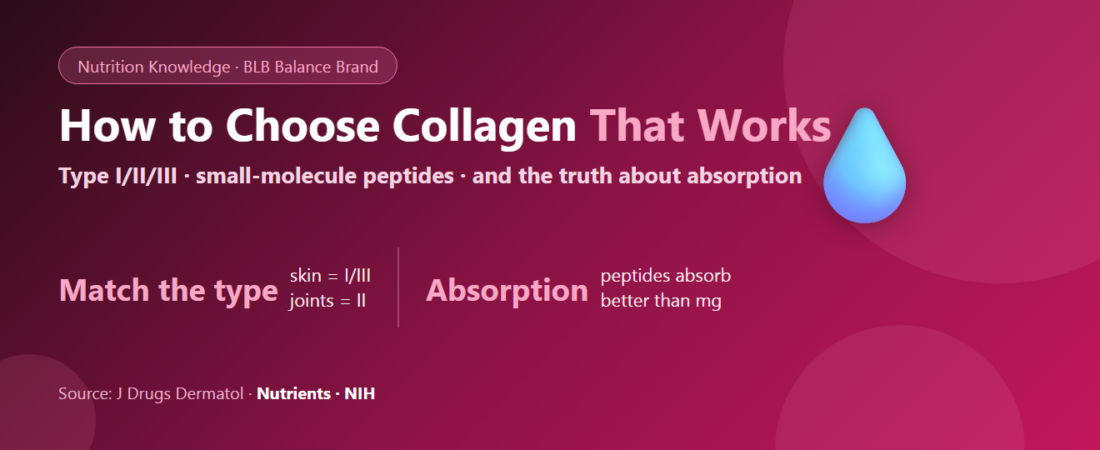
Collagen is one of the most popular supplements for skin and joints — but the market is drowning in marketing buzzwords: dipeptides, “small molecules,” Type I/II/III, marine-sourced, 10,000 mg. It’s hard to tell what actually works. And there’s a nagging question: when you drink collagen, does your body really absorb it and use it to build skin — or is it just broken down and wasted? This article explains it in plain terms so you can choose wisely, not by advertising.
tendons
after age 25–30
mg number
Collagen is the most abundant structural protein in the body — the main building block of skin, joints, bone, tendons and blood vessels. Your body makes its own, but production drops with age (typically after 25–30), which is why skin starts to sag and joints wear over time. That’s the reason interest in supplementing has grown.
1 Collagen comes in several types — choose by your goal
| Type | Where it is | Best for |
|---|---|---|
| Type I | skin, bone, tendons (most abundant) | skin & elasticity |
| Type II | cartilage in joints | joints |
| Type III | skin, blood vessels (often paired with Type I) | skin & structure |
Fish / marine collagen is mostly Type I, which is why it’s popular for skin care. What to look for: match the type to your goal (skin = Type I/III · joints = Type II).
2 Why “small molecules / peptides” matter
- Large collagen molecules are hard to absorb — the body has to break them down first. That’s why manufacturers make collagen peptides / hydrolyzed collagen (pre-broken into smaller pieces) for better absorption.
- The smaller it is (di/tripeptides), the better it tends to absorb — which is why “molecular size (Daltons)” is used as a selling point.
- But a high mg number doesn’t mean it’s better if absorption is poor. Look at the type, the hydrolysis, and the supporting ingredients.
3 Does drinking collagen actually work — what the research says
This is hotly debated. When you consume collagen, it’s broken down into amino acids and small peptides before absorption. The question is whether it can go on to build skin:
- Some studies show promising trends — certain trials found collagen peptides may help skin hydration and elasticity, and joint symptoms in some groups.
- But results vary between individuals, and the research has limits (group size, duration, funding).
- It’s not instant — you need to take it consistently and care for your skin holistically (sun protection, sleep, diet).
⚠️ Dietary supplements are a support for skin/joints, not a medicine; they do not treat skin or joint diseases.
4 Vitamin C — the partner collagen can’t do without
Your body needs vitamin C to make collagen. So getting enough vitamin C is important to this process, which is why many formulas pair the two. Taking collagen without adequate vitamin C may mean you don’t get the full benefit.
💡 Did you know? BLB C is a drink-mix skin formula that combines multi-molecular-weight fish collagen + vitamin C + astaxanthin + glutathione + Zinc/B/D3 — designed so collagen works together with the vitamin C and antioxidants your skin needs. FDA reg. 26-1-10867-5-0032. A dietary supplement, not a medicine; it does not treat any disease. Good skin care also needs sun protection and rest.
5 Frequently Asked Questions (FAQ)
Does collagen really improve skin?
There is research showing promising trends for skin hydration and elasticity, but results vary between people and are not instant, and it works alongside holistic care — not collagen alone.
Are small-molecule collagens really better?
Small molecules (peptides) generally absorb better than large collagen, but you also need to consider the type and supporting ingredients — not just the Dalton or mg number.
Is fish collagen different from bovine collagen?
Fish collagen is mostly Type I, suited to skin care and well absorbed. Choose by the type you need. Those with seafood allergies should check the fish source.
Should I take collagen with vitamin C?
Yes. The body uses vitamin C to build collagen, so adequate vitamin C helps the process work better — which is why many formulas include it.
When is the best time to take collagen?
Either on an empty stomach in the morning or before bed, as the product directs. Consistency matters more than timing.
At what age should I start collagen?
The body makes less collagen after 25–30, but supplementing is a personal choice. Sun protection and basic skin care matter just as much.
6 Precautions
- People with seafood allergies should check the collagen source (fish).
- Collagen is not a medicine for skin or joint disease — results vary between individuals.
- Look at the type and hydrolysis, not just the mg number.
- Dietary supplements are not medicine — they do not prevent, treat, or cure disease; they only support health.
- Pregnant/breastfeeding women and those with underlying conditions should consult a doctor first.
7 Summary
- Collagen is the structural protein of skin, joints and bone that declines with age.
- Match the type to your goal — skin = Type I/III (often from fish) · joints = Type II.
- Small molecules/peptides absorb better, but check the type and ingredients too, not just numbers.
- Pair it with vitamin C and care for skin holistically (sun protection, sleep, diet).
Good collagen isn’t about the highest mg or the fanciest ad — it’s about choosing the right type, good absorption, pairing with vitamin C, and combining it with basic skin care. That’s how you get real benefit without overpaying.
References
- Choi FD, et al. Oral Collagen Supplementation: A Systematic Review of Dermatological Applications. J Drugs Dermatol.
- León-López A, et al. Hydrolyzed Collagen—Sources and Applications. Molecules.
- NIH / MedlinePlus — Collagen.
- Paul C, et al. Significant Amounts of Functional Collagen Peptides Can Be Incorporated. Nutrients.
💡 Looking for a skin-care helper? Read next: Collagen + multivitamin: which brand to choose 👉