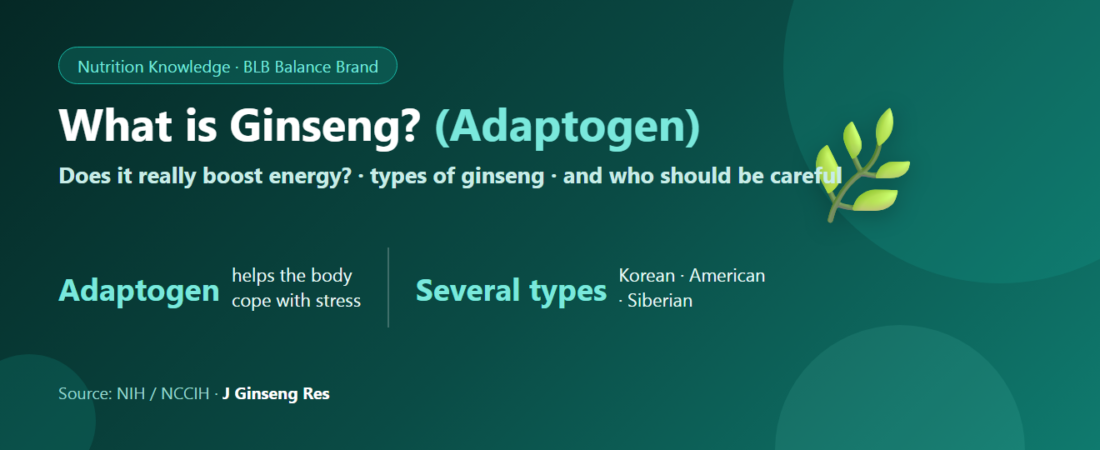
Ginseng has been known to Asian cultures for thousands of years as a tonic for strength and recovery. Today it’s popular again under the name “adaptogen” — a herb said to help the body cope with stress and fatigue. But what exactly is ginseng, how many types are there, does it really help with energy, and who should be careful? This article explains it clearly and based on evidence.
cope with stress
· Siberian
stimulant
Ginseng is the root of plants in the Panax genus, whose key actives are called ginsenosides. It’s classified as an “adaptogen” — a group of herbs believed to help the body adapt to physical and mental stress. This is different from a stimulant like caffeine, which gives a temporary lift that then wears off.
1 How many types of ginseng — and how do they differ?
| Type | Highlights |
|---|---|
| Korean ginseng (Panax ginseng) | the most popular · linked to energy, vitality and immunity · comes as “red ginseng” (steamed/dried) and “white ginseng” |
| American ginseng (Panax quinquefolius) | a “cooler” character · often linked to relaxation and immunity |
| Siberian ginseng (Eleuthero) | not a true Panax · a different class of adaptogen |
“Red” vs “white” ginseng: the difference is in processing. Red ginseng is steamed, which transforms some compounds, and is favored for its tonic effect.
2 What does ginseng help with — what does research say?
- Fatigue/energy — there is research on ginseng and feelings of tiredness, especially in people with chronic fatigue · results are still mixed
- Immunity — studies exist on immune modulation
- Focus/memory — some preliminary research
- Adaptogen — the idea of helping the body cope with stress still needs more research
⚠️ Dietary supplements are a support for health, not a medicine, and do not treat disease. Ginseng is not an instant tonic, and effects vary between individuals.
3 Who should be careful — ginseng isn’t for everyone
- People with abnormally high/low blood pressure — ginseng may affect blood pressure; consult a doctor
- People on blood thinners or diabetes medication — ginseng may interact with these drugs
- People who don’t sleep easily — some ginseng may be stimulating; avoid in the evening/before bed
- Pregnant/breastfeeding women — consult a doctor first
💡 Did you know? Ginseng is often combined with other restorative herbs for holistic health care. BLB U blends 13 extracts, including Korean ginseng, cordyceps, 4 medicinal mushrooms, beta-glucan and CoQ10 — focused on immune care and energy recovery. FDA reg. 26-1-10867-5-0049. A dietary supplement, not a medicine; it does not prevent or treat disease. Those with underlying conditions or on medication should consult a doctor first.
4 Frequently Asked Questions (FAQ)
Does ginseng really help energy / relieve tiredness?
There is research on ginseng and fatigue, especially in people with chronic tiredness, but results vary between individuals and are not instant. Ginseng is a support, not a fatigue cure.
How is ginseng different from caffeine?
Caffeine is a stimulant that gives a temporary lift that then wears off. Ginseng is an adaptogen whose concept is to help the body adapt to stress — not the same kind of stimulation.
Is red or white ginseng better?
They differ by processing. Red ginseng is steamed and favored for its tonic effect. Choose what suits you — neither is “better” for everyone.
When is the best time to take ginseng?
Usually morning or midday, because some ginseng can be stimulating and taking it in the evening/before bed may disrupt sleep in some people.
Can I take ginseng every day?
Generally yes, in an appropriate amount, though some guidance suggests taking breaks. Those with underlying conditions or on medication should consult a doctor.
Who should not take ginseng?
People with abnormal blood pressure, on blood thinners/diabetes medication, who don’t sleep easily, or who are pregnant/breastfeeding should consult a doctor first.
5 Precautions
- People with abnormal blood pressure or on regular medication (blood thinners/diabetes) should consult a doctor first.
- May disrupt sleep — avoid in the evening/before bed if you’re sensitive to stimulation.
- Ginseng is not an instant tonic and is not a medicine for any disease.
- Dietary supplements are not medicine — they do not prevent, treat, or cure disease; they only support health.
- Pregnant/breastfeeding women and children should consult a doctor first.
6 Summary
- Ginseng is a Panax-genus root rich in ginsenosides, classed as an adaptogen.
- There are several types — Korean (red/white), American, Siberian — with different effects.
- Research exists on energy, fatigue and immunity, but results are mixed and not instant.
- It’s not for everyone — abnormal blood pressure, regular medication, or poor sleep warrant a doctor’s advice.
Ginseng is a herb with a long history and some supporting research — but it’s not a miracle cure. Understand the types, choose what suits you, take it at the right time, and consult a doctor if you have an underlying condition to benefit safely.
References
- NIH / NCCIH — Asian Ginseng.
- Arring NM, et al. Ginseng as a Treatment for Fatigue: A Systematic Review. J Altern Complement Med.
- Kim JH, et al. Role of Ginsenosides, the main active components of Panax ginseng. J Ginseng Res.
- NIH / MedlinePlus — Ginseng, Panax.
💡 Looking for a wellness helper? Read next: Immune-support supplements: which brand to choose 👉