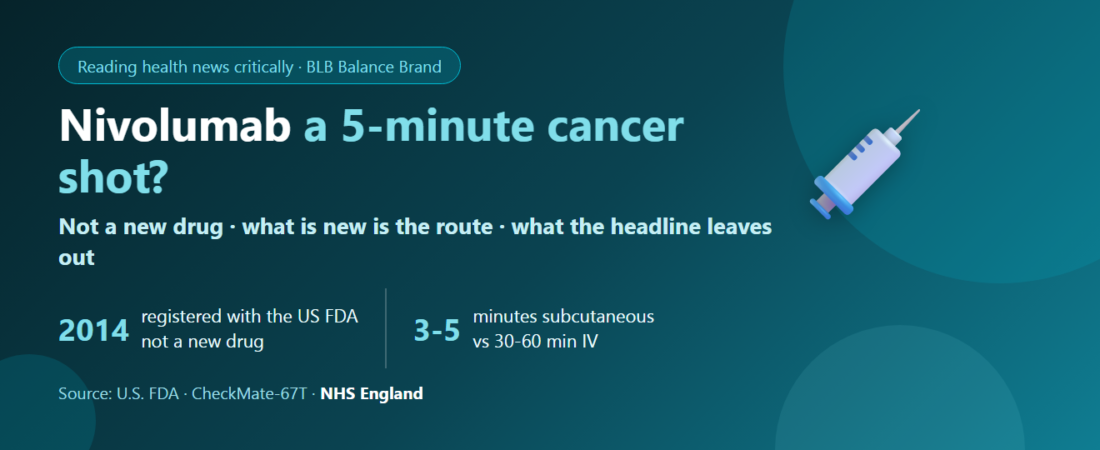
“England’s NHS rolls out a new cancer injection covering up to 15 types of cancer — and it takes just 5 minutes!” — an exciting headline, isn’t it? · Cancer-drug news is almost always headlined as a “miracle” · But once you know the full facts, the excitement usually settles down · Let’s get to know this drug without the hype: what it actually is, what is genuinely new about it, and what the headlines “leave out”.
with the FDA since 2014
instead of 30-60 min IV
some cancers need chemo too
The news everyone is sharing is about Nivolumab (brand name Opdivo) in its “subcutaneous injection” form, which was approved by the U.S. FDA in late 2024 and which several health systems have started using in practice · What excites people is the “just a few minutes” part · But what the headlines usually do not say is — the drug itself is not new, and it is not a “one shot and the cancer is gone” treatment · This article is knowledge to help you read the news critically, not treatment advice · Cancer treatment must be under the care of a specialist physician only.
1 What Nivolumab is — and why it is not new
Nivolumab belongs to the “immunotherapy” class of drugs, specifically a PD-1 inhibitor · The principle is to “release the brake” so the body’s own immune system can see and deal with cancer cells better · This drug has been registered with the U.S. FDA since 2014 and there is continuing research showing it works for several types of cancer (melanoma, lung, kidney, head and neck, and others)
So the phrase “covering 15 types” in the headline actually refers to indications accumulated over many years — not to a newly discovered drug that treats 15 diseases in a single injection.
2 So what is actually new about the “subcutaneous” form?
The original Nivolumab is given by intravenous infusion (IV), which takes around 30-60 minutes per session · The new one is the subcutaneous (SC) injection form, which takes only 3-5 minutes
Referring to the key trial named CheckMate-67T, which compared the 2 injection routes, the conclusions were:
| Aspect | Comparison, SC vs IV |
|---|---|
| Efficacy | Not inferior (non-inferior) — response rate (ORR) and disease control (PFS) were similar |
| Safety | Overall side effects were similar (SC may have mild injection-site reactions) |
| Convenience | ✅ The genuine advantage — far faster to give, less time in hospital, less burden on staff |
So the real “big news” is about “convenience” — patients spend less time, not that the drug has become more effective than before.
3 ⚠️ What the headlines “do not tell you”
• It is not “one injection and you are cured” — it must be given in continuous cycles according to the treatment plan
• Many cancers require it together with chemotherapy or other treatments; it is not always a single-agent drug
• It does not work for everyone or for every cancer — it depends on the type and stage of the disease; the doctor decides
• It has immune-related side effects that need close monitoring
• It is very expensive and still not reimbursable under many health-coverage schemes — a major obstacle in practice
4 The lesson — how to read health news without getting over-excited
- Be wary of headlines with thrilling numbers (“15 types”, “5 minutes”) — they usually cut out the important context
- Ask “is the drug new, or is the way of giving it new?” — these two things are very different
- Look for the words non-inferior / equivalent — they mean “not worse”, not “better”
- Look at the real price and access — a good drug that is expensive and not reimbursable is still a limitation
- Trust sources that cite research or doctors more than a headline that gets shared around
🚨 Important cancer warning · Cancer treatment must be under the care of an oncology specialist only · Beware of advertisements or news claiming that “foods”, “herbs” or “dietary supplements” can treat cancer — these things have no effect in preventing, alleviating or treating cancer, and believing them to the point of neglecting proper treatment can be life-threatening · If you have any doubt about treatment, consult a doctor; do not believe advertising claims.
5 Summary
- Nivolumab is not a new drug — it is an immunotherapy that has been in use since 2014
- What is new is the “route” — subcutaneous, 3-5 minutes (more convenient, not more effective)
- It is not a magic bullet — given in cycles, some cancers need chemotherapy alongside it, very expensive and hard to get reimbursed
- Seeing through headlines is an essential skill in an age of information overload
Medical progress is something to be glad about — but understanding “the complete facts” matters just as much as being excited by the news · With cancer especially, what you need is accurate information and a doctor’s care, not hope built on a headline or an advertisement.
References
- U.S. FDA — Nivolumab (Opdivo) approval history & subcutaneous formulation.
- CheckMate-67T trial — Subcutaneous vs Intravenous Nivolumab (non-inferiority study).
- NHS England — Faster subcutaneous cancer immunotherapy rollout.
- National Cancer Institute (NCI) — Immune checkpoint inhibitors.