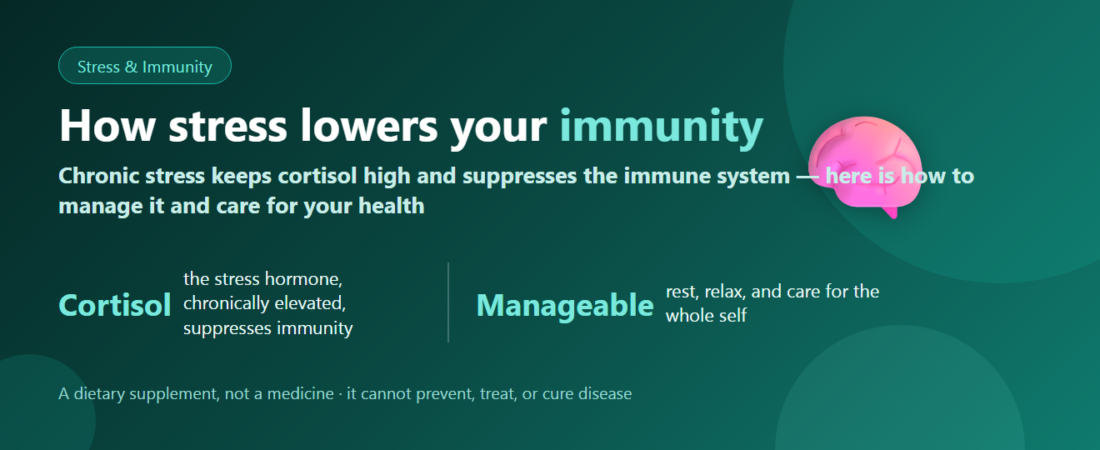
“Stress lowering your immunity” is not just a figure of speech — chronic stress can genuinely affect the immune system in scientific terms · Many people notice that during periods of heavy stress, hard work, and little rest, they tend to catch colds, get cold sores, or fall ill more easily than usual · How does stress weaken immunity, and how can we manage stress to take care of our health? · This article explains it in an easy-to-understand way
via stress hormones
chronically elevated
care for the whole self
When we are stressed, the body releases stress hormones such as cortisol (Cortisol) · In the short term this hormone is beneficial, helping us cope with situations · But when stress becomes chronic, continuously elevated cortisol suppresses the function of the immune system, making the body less able to fight off pathogens · Managing stress is therefore part of caring for your health and immunity
1 How chronic stress affects immunity
| Effect | Details |
|---|---|
| Suppresses immune-cell function | Chronically high cortisol reduces the efficiency of cells that fight pathogens |
| Get sick easily, recover slowly | Colds, cold sores, or infections become more likely during stressful periods |
| Chronic inflammation | Stress is associated with low-grade inflammation in the body |
| Affects sleep and the gut | Stress → poor sleep + gut disturbance → loops back to affect immunity again |
2 Signs that stress is affecting your body
- Getting sick more often, catching colds/cold sores easily, recovering slowly
- Trouble falling asleep, or restless sleep
- Fatigue, exhaustion, lack of freshness
- Headaches, muscle aches, digestive upset
- Easily irritable, short attention span
3 How to manage stress to care for immunity
- Sleep enough — sleep helps restore both mood and immunity
- Exercise regularly — helps reduce stress hormones and improve mood
- Practice relaxation — deep breathing, meditation, yoga, or activities you enjoy
- Eat a balanced diet — especially vegetables, fruit, and nutrients related to immunity
- Connect with those around you — talking/venting helps reduce stress
- Prioritize / take regular breaks — don’t overexert yourself
💡 Take care of yourself during heavy stress · During periods of little rest and accumulated stress, holistic immune care can help · BLB U is a dietary supplement that combines immune-supporting and body-restoring ingredients such as 4 kinds of mushrooms, 90% beta-glucan, cordyceps, and Korean ginseng — suited to people who work hard, rest little, and want to look after their immunity · It is a dietary supplement, not a medicine; it has no effect in preventing, treating, or curing disease · Managing stress and getting enough rest remain the most important foundation
4 Frequently Asked Questions (FAQ)
Is it true that stress makes you get sick more easily?
Yes · Chronic stress keeps the hormone cortisol continuously elevated, which suppresses immune function, making you get sick more easily and recover more slowly
Why do I get cold sores/mouth ulcers when stressed?
Stress that suppresses immunity may allow dormant viruses (such as the herpes virus) to flare up · It is a sign that the body is becoming worn out
How can I manage stress to improve immunity?
Sleep enough, exercise, practice relaxation, eat well, and maintain good relationships with those around you — this helps reduce stress hormones and care for immunity
Can supplements help with stress-related lowered immunity?
Supplements are only an aid for health care · The most important thing is to manage the root cause of stress, rest, and take care of yourself in every aspect
What kind of stress should prompt seeing a doctor/specialist?
If stress/anxiety is severe, affects daily life or sleep, or there is persistent low mood, you should consult a doctor or a mental-health specialist
5 Precautions
- Severe or chronic stress/anxiety should be discussed with a doctor or specialist
- Getting sick unusually often may have other underlying causes and should be checked by a doctor
- Do not use supplements as a substitute for managing stress and rest
- Dietary supplements are not medicine — they have no effect in preventing, treating, or curing disease; they are only an aid for health care
6 Summary
- Chronic stress suppresses immunity through continuously elevated cortisol
- The result is getting sick easily and recovering slowly — catching colds/cold sores easily during stressful times
- It is manageable — sleep enough, exercise, relax, eat well, and have good social connections
- Severe/chronic stress should be discussed with a specialist
Body and mind are connected — caring for your emotions and stress is therefore part of having a strong immune system · Start by getting enough rest, moving your body, and finding time to relax each day
References
- American Psychological Association — Stress effects on the body.
- NIH — Stress and immune function.
- Harvard Health — Understanding the stress response.
- Mayo Clinic — Chronic stress.
💡 Looking for something to help you care for yourself? Read on: Which magnesium brand is best — choose wisely 👉