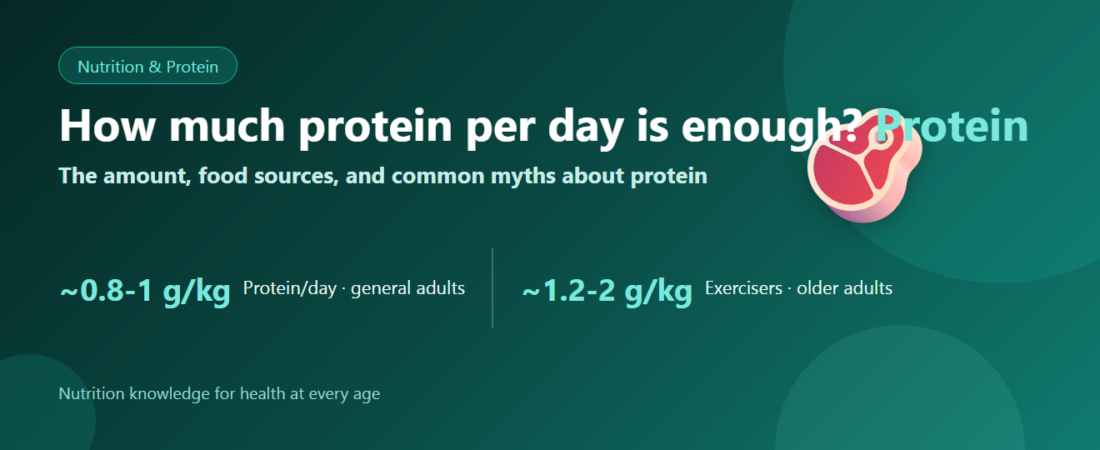
“How much protein do I need per day?” · “Does too much protein really damage the kidneys?” · “Do older adults need to eat more protein?” — protein questions many people wonder about · Protein is an essential macronutrient the body cannot do without, used to build and repair muscle, enzymes, and immunity · This article answers it all: the amount, food sources, and common myths about protein
General adults
Older adults
Immunity
Protein is a macronutrient (macronutrient) made up of amino acids · The body uses protein to build and repair muscle, produce enzymes and hormones, build immunity, and much more · Getting enough protein is therefore important for health at every age · This information is nutritional knowledge, not individual medical advice
1 How much protein you need per day
| Group | Protein amount (approximate) |
|---|---|
| General adults | ~0.8-1 gram per 1 kg of body weight/day |
| People who exercise/build muscle | ~1.2-2 grams/kg/day |
| Older adults | Need slightly more to maintain muscle mass |
| Pregnant/breastfeeding women | Need more (per doctor’s advice) |
Example: a person weighing 60 kg generally needs about 48-60 grams of protein/day · Spread protein across each meal, rather than piling it into a single meal
2 Good protein sources
| Type | Examples |
|---|---|
| Animal protein | Lean meat, chicken, fish, eggs, milk, yogurt (complete protein) |
| Plant protein | Various beans, tofu, soy, grains, seeds |
| Fish | Provides both protein and omega-3 |
Eating a variety of protein from both animals and plants helps you get complete amino acids · Vegetarians should mix several types of plant protein sources
3 Protein and older age — why it matters
As we age, muscle mass tends to decline (low muscle mass/Sarcopenia) causing weakness and a risk of falls · Older adults therefore need enough protein, together with resistance exercise, to maintain muscle mass · Yet many people eat less protein as they age, which deserves special attention
4 Common myths about protein
“Eating a lot of protein damages the kidneys” — true only in certain cases: In people with normal kidneys, eating protein at an appropriate level does not damage the kidneys · But in people who already have kidney disease, protein must be limited as advised by a doctor · So people with kidney disease should consult a doctor about protein amounts
- “Protein alone can build muscle” — not true, resistance exercise is also required
- “The more protein the better” — beyond the body’s needs it can’t all be used, so keep it moderate
💡 Care for your muscles and body recovery · Besides adequate protein, caring for overall body recovery also matters, especially for people who work hard or rest little · BLB U is a dietary supplement that focuses on body recovery and immune support with ingredients such as 4 types of mushrooms, 90% beta-glucan, cordyceps, and Korean ginseng · It is a dietary supplement, not a medicine, has no effect in preventing, treating, or curing disease, and is not a meal-replacement protein product · Getting enough protein from food remains the most important foundation
5 Frequently Asked Questions (FAQ)
How much protein per day is enough?
General adults need about 0.8-1 gram per 1 kg of body weight per day · People who exercise or older adults need more · Spread it across each meal
Does a lot of protein really damage the kidneys?
In people with normal kidneys, protein at an appropriate level does not damage the kidneys · But people with kidney disease must limit protein as advised by a doctor
Is plant protein as good as animal protein?
Some plant proteins have less complete amino acids than animal protein · But eating several types of plants together helps you get the full set · Suitable for vegetarians
Do I need to take protein shakes or supplements?
If you eat a complete diet and get enough protein, it isn’t necessary · Protein supplements are a helper for people who don’t eat enough or have high needs, not something everyone requires
How should older adults eat protein?
They should get enough protein spread across every meal, together with resistance exercise, to maintain muscle mass · If they have underlying conditions they should consult a doctor
6 Precautions
- People with kidney disease must limit protein and consult a doctor about the amount
- Don’t take protein supplements beyond what is needed — focus mainly on protein from food
- Building muscle requires exercise alongside, not just eating protein
- Dietary supplements are not medicine — they have no effect in preventing, treating, or curing disease; they are only a helper for looking after health
7 Summary
- Protein is essential for muscle, immunity, and body repair
- General adults need ~0.8-1 g/kg/day · exercisers/older adults need more
- Eat a variety — meat, eggs, fish, milk, beans, tofu
- People with normal kidneys who eat moderately do not damage their kidneys · people with kidney disease must consult a doctor
With protein, “moderate and consistent” matters most — no need for too much, but you must get enough each day · Especially older adults, who should pay attention to protein to maintain muscle mass and strength
References
- NIH / MedlinePlus — Protein in diet.
- Harvard T.H. Chan School of Public Health — Protein.
- WHO/FAO — Protein and amino acid requirements.
- Academy of Nutrition and Dietetics — Protein needs.