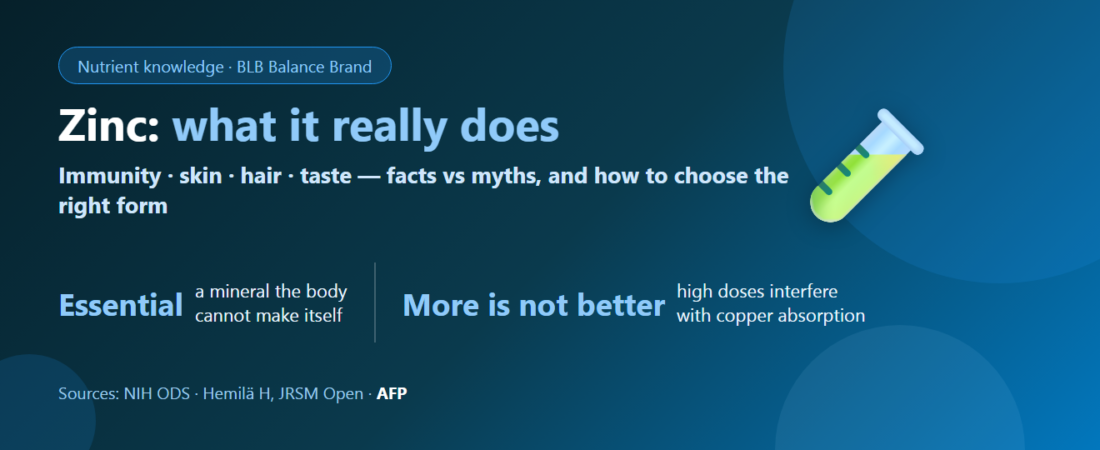
Zinc is the mineral people bring up whenever they catch a cold, break out in acne, or notice hair falling out · Some take it because they heard it “boosts testosterone” · But what does zinc actually do in the body, how much do you need, which form is best, and which claims are true and which are just belief · This article pulls it all together in plain, evidence-based language
it must come from food
· sense of taste
copper absorption
Zinc is an essential mineral involved in several hundred enzymes in the body — it plays a role in the immune system, wound healing, skin and hair health, taste and smell, and growth · The body cannot make it and can store only a limited amount, so it has to be taken in regularly
1 What zinc does in the body
- Immune system — needed for immune cells to function
- Skin and wound healing — involved in tissue repair · which is why it gets linked to acne
- Hair and nails — zinc deficiency is associated with hair loss in some cases
- Taste and smell — a lack of zinc may alter the sense of taste
- Men’s health — involved in hormone function, but it needs to be understood accurately (see section 3)
2 Signs that may point to zinc deficiency
- Weak immunity, getting sick easily, wounds healing slowly
- Unusual hair loss, brittle nails, white spots
- Changes in taste/smell, poor appetite
- Skin problems, persistent acne (in some people)
These symptoms are not specific · Severe zinc deficiency is uncommon in people who eat a varied diet, but some groups (vegetarians, older adults, people with absorption problems) are at higher risk
3 Separating fact from myth
| Myth | Fact |
|---|---|
| “Taking zinc keeps pushing testosterone higher and higher” | Zinc is necessary for hormone function · supplementation only helps people who are deficient — it does not push hormones above normal in people who already get enough |
| “Zinc cures colds” | It may slightly reduce the duration of a cold if started early (in some studies) · it is not a medicine that treats or prevents colds |
| “Zinc can cure acne” | It is involved in skin and inflammation · it is a supportive aid, not an acne medicine |
4 How much, which form, and the warning about “too much”
- The daily amount for adults is in the range of “a little over ten milligrams” · obtained from foods such as meat, oysters, nuts and pumpkin seeds
- Well-absorbed forms such as zinc bisglycinate, gluconate and picolinate are usually absorbed better than zinc oxide
- Do not overdo it — high-dose zinc taken for a long time interferes with copper absorption and can lead to copper deficiency · and it may cause nausea · more is not better
- Some combinations matter — high-dose iron/calcium may compete for absorption
💡 Did you know? Some ordinary zinc forms are absorbed only to a limited extent and may irritate the stomach · Lipo Zn from BLB is a Liposomal zinc combined with Vitamin C, L-Cysteine, Quercetin and Selenium — designed to support absorption and to care for skin, hair and immunity · Thai FDA 26-1-10867-5-0059 · this is a dietary supplement, not a medicine, not a medicine for acne/colds, and it has no effect in curing disease
5 Frequently asked questions (FAQ)
Does zinc really help with acne?
Zinc is involved in skin and inflammation, and some people use it to help care for acne · but it is not an acne medicine · severe acne should be seen by a dermatologist; zinc is only a supportive aid
Can zinc increase testosterone?
Zinc is necessary for hormone function · supplementation only helps people who are deficient — it does not push hormones above normal in people who get enough · it is not a performance-enhancing drug
Does taking zinc help when you have a cold?
Some studies have found it may slightly reduce the duration of a cold if started early · but the evidence is still mixed and it is not a medicine that treats colds
Is taking a lot of zinc dangerous?
High doses over a long period interfere with copper absorption and may cause nausea · it should be kept to a sensible amount; more is not better
When should zinc be taken?
Many formulas suggest an empty stomach for absorption, but if it irritates your stomach take it with food · avoid taking it together with high-dose iron/calcium at the same time
Who should be careful with zinc supplementation?
People taking certain antibiotics, people on regular medication, or those with underlying conditions should consult a doctor first, because zinc may interact with some drugs
6 Precautions
- Do not take high-dose zinc for a long time without consulting a doctor — it interferes with copper absorption
- Zinc is not a medicine for acne or colds, and not a hormone-boosting drug
- It may interact with some medicines (for example certain groups of antibiotics) — space them apart and see a doctor
- A dietary supplement is not a medicine; it has no effect in preventing, alleviating or curing disease and is only an aid for looking after your health
- Pregnant/breastfeeding women and children should see a doctor about the appropriate amount
7 Summary
- Zinc is a mineral essential to immunity, skin, hair, taste and wound healing
- It only helps people who are deficient — it is not a hormone-boosting drug or a medicine for acne/colds
- Choose a well-absorbed form and do not overdo it, because excess affects copper absorption
- Get it mainly from food and supplement when necessary
Zinc is a small mineral with a big role — understand it accurately, choose a suitable amount and form, get it mainly from food, and see a doctor if you have an underlying condition; you will look after your health well without the risk that comes from taking too much
References
- NIH Office of Dietary Supplements — Zinc Fact Sheet for Health Professionals.
- Hemilä H. Zinc lozenges and the common cold: a meta-analysis. JRSM Open.
- Saper RB, Rash R. Zinc: An Essential Micronutrient. American Family Physician.
- Wessells KR, Brown KH. Estimating the Global Prevalence of Zinc Deficiency. PLoS One.
💡 Looking for something to help? Read next: Acne supplements and zinc — which brand is good and how to choose wisely 👉