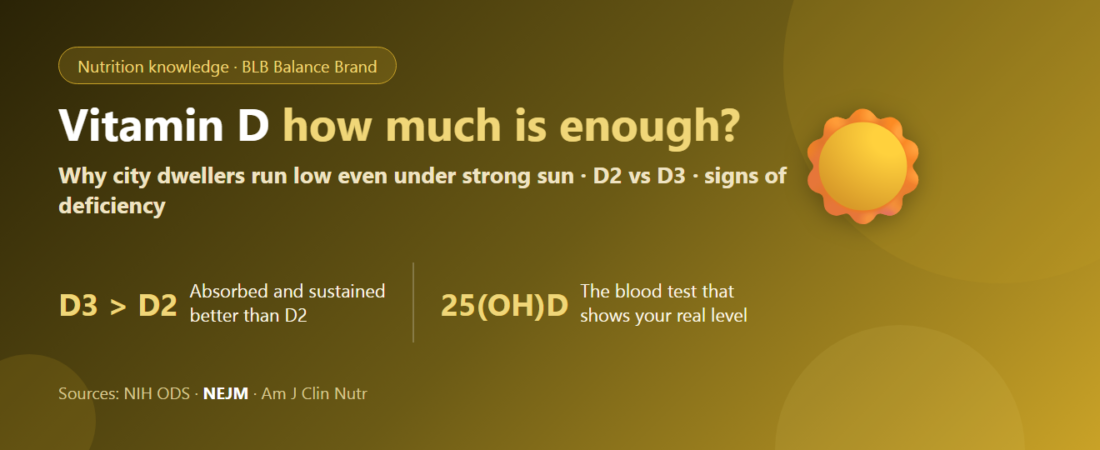
Vitamin D is called the “sunshine vitamin” because the body makes it when the skin is exposed to sunlight · Yet many city dwellers are deficient in vitamin D even though they live in a hot, sunny country · Many people wonder how much they need, how D2 differs from D3, and whether sun exposure alone is enough · This article answers it all in plain language, along with the signs that you may be running low
are often deficient
sustained better
shows your level
Vitamin D is a fat-soluble vitamin with an important role in bone health, calcium absorption, muscles and the immune system · Even though Thailand gets strong sunshine, staying indoors, using sunscreen and wearing covering clothing mean many people do not get enough sun to make vitamin D
1 Signs that may indicate vitamin D deficiency
- Fatigue and tiring easily with no clear cause
- Muscle aches and bone pain
- Muscle weakness — difficulty standing up and sitting down in older adults
- Getting sick easily, weaker immunity
- Low mood especially in people who get little sunlight
These symptoms are non-specific and may come from other causes · A 25(OH)D blood test is the way to confirm your vitamin D level for certain
2 How D2 differs from D3
| Type | Source | Notes |
|---|---|---|
| Vitamin D3 (Cholecalciferol) | Made by the skin in sunlight · found in fish and egg yolk | Absorbed and sustained in the blood better · the form most commonly used in supplements |
| Vitamin D2 (Ergocalciferol) | From plants and certain mushrooms | The body can use it, but it sustains levels less well than D3 |
In short: if you have a choice, D3 is the form research supports as better at sustaining vitamin D levels
3 How much vitamin D do you need, and is sunlight enough?
- The recommended daily amount varies with age and health status · in general adults fall in the range of “several hundred IU per day”, but people who are deficient may need more as advised by a doctor
- Sunlight — exposing your arms and legs to mid-morning sun for about 10-15 minutes, a few times a week, helps produce vitamin D · but it depends on skin tone, sunscreen and the time of day
- Food — fatty fish (salmon, tuna), egg yolk, sun-exposed mushrooms, and vitamin D supplements
⚠️ Do not take high-dose vitamin D on your own for long periods without consulting a doctor, because vitamin D is fat-soluble and can accumulate · getting too much has harmful effects
💡 Did you know? Vitamin D is fat-soluble, so absorption depends on the form and on taking it together with fat · Lipo D3 from BLB is a Liposomal vitamin D3, designed to support absorption, suitable for people who get little sunlight and want to care for their bones, muscles and immune system · It is a dietary supplement, not a medicine, and has no disease-treating effect; people with specific conditions should consult a doctor about the dose
4 Who is at particular risk of vitamin D deficiency
- People who work indoors and get little sunlight
- Older adults — the skin produces less vitamin D
- People with darker skin — melanin reduces vitamin D production from sunlight
- People who always use sunscreen or keep their body covered
- People with fat malabsorption conditions
5 Frequently asked questions (FAQ)
Thailand has strong sun — can you really still be deficient in vitamin D?
Yes · even with strong sunshine, staying indoors, using sunscreen and wearing covering clothing mean the skin does not make enough vitamin D · deficiency is common even in hot countries
D2 or D3 — which one should you choose?
In general D3 sustains blood vitamin D levels better, so it is the form most used in supplements · but the body can use both
When is the best time to take vitamin D?
Because it is fat-soluble, you should take it with a meal that contains fat for better absorption
Is more vitamin D always better?
No · vitamin D accumulates in the body, and getting too much over a long period has harmful effects such as high blood calcium · stay within an appropriate amount and consult a doctor if a high dose is needed
Should you have your vitamin D level tested?
People with suspicious symptoms or a risk of deficiency should consult a doctor for a 25(OH)D blood test to know their exact level and supplement to the point
Does vitamin D really help immunity?
Vitamin D plays a role in the immune system, and deficiency is linked with poorer immunity · but it is not a medicine that prevents infection · getting enough vitamin D is one part of overall health
6 Precautions
- Do not take high-dose vitamin D on your own for long periods without consulting a doctor — it accumulates and has harmful effects in excess
- People with kidney disease, high blood calcium, or those taking regular medication should consult a doctor first
- Vitamin D is not a medicine for treating disease and not an infection preventive
- Dietary supplements are not medicines — they have no effect in preventing, treating or curing disease; they are only an aid for looking after your health
- Pregnant and breastfeeding women should consult a doctor about an appropriate dose
7 Summary
- Vitamin D matters for bones, muscles and immunity — city dwellers can be deficient even under strong sun
- D3 sustains levels better than D2
- You get it from sunlight, food and supplements — the amount depends on age and health status
- A 25(OH)D blood test tells you your exact level · do not take high doses on your own for long periods
Vitamin D is easy to overlook but important — know whether you are at risk of deficiency, choose well-absorbed D3, get a sensible amount of sun and the right foods, and have a blood test if in doubt, and you will look after your bones and overall health better
References
- NIH Office of Dietary Supplements — Vitamin D Fact Sheet for Health Professionals.
- Holick MF. Vitamin D Deficiency. New England Journal of Medicine.
- Tripkovic L, et al. Comparison of vitamin D2 and D3 supplementation in raising serum 25(OH)D. Am J Clin Nutr.
- Royal College of Physicians of Thailand — vitamin D recommendations.
💡 Looking for something to help? Read next: Which vitamin D brand is best — choose wisely 👉