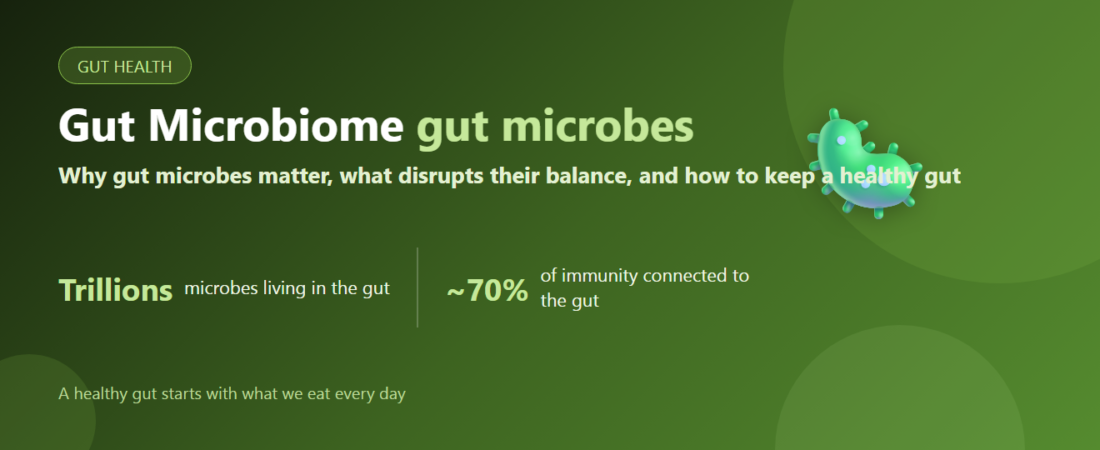
Inside our gut live trillions of “microbes” — even more than the number of cells in the body · These microbes (Gut Microbiome) don’t just sit idle; they work on digestion, immunity, and even mood · Why do gut microbes matter, what disrupts their balance, and how can we keep a “healthy gut”? · This article explains it in simple terms
living in the gut
the gut
over bad microbes
The Gut Microbiome is the ecosystem of microbes (bacteria, etc.) that live in our gut · When good and bad microbes stay in the right balance, the gut works well · But when the balance is off (dysbiosis), it may be linked to problems with digestion, immunity, and overall health · Caring for gut microbes is part of looking after your health, not treating a disease
1 What do gut microbes do
| Role | Details |
|---|---|
| Help digest food/fiber | Break down fiber the body can’t digest on its own, and produce substances good for the gut |
| Make certain vitamins | Such as vitamin K and some B vitamins |
| Involved in immunity | The gut is home to a large number of immune cells |
| Linked to the brain (Gut-Brain Axis) | The gut and brain communicate, so it relates to mood and feelings |
2 What disrupts the balance of gut microbes
- Processed food, high sugar, bad fats — feed undesirable microbes
- Eating little fiber — good microbes lack their “food” (prebiotics)
- Overusing antibiotics — kill both good and bad microbes (use only as prescribed by a doctor)
- Chronic stress and too little sleep — affect gut balance through the gut-brain axis
- Heavy alcohol drinking, smoking
3 How to keep gut microbes balanced
- Eat a variety of fiber — vegetables, fruit, whole grains, beans (food for good microbes)
- Eat fermented foods — such as yogurt and kimchi, which contain good microbes (probiotics)
- Cut down on sugar and processed food
- Eat a diverse diet — diversity of food = diversity of microbes
- Manage stress, get enough sleep, exercise
- Use antibiotics only when necessary, as prescribed by a doctor
💡 Care for your gut with fiber and balanced microbes · A healthy gut needs both prebiotics (food for good microbes) and probiotics (good microbes) · BLB F is a fiber-group dietary supplement that combines prebiotics, probiotics, and postbiotics (such as Psyllium, Inulin, and the microbe Bacillus coagulans) — helping support the digestive system and gut balance · Suitable for people who eat few vegetables or want to look after their gut · It is a dietary supplement, not a medicine, and has no effect in preventing, alleviating, or treating any disease · Eating a diverse, fiber-rich diet remains the most important foundation
4 The gut and mood — the gut-brain axis
The gut is called the “second brain” because it has a large network of nerves and communicates with the brain in both directions · Gut microbes are involved in producing certain neurotransmitters · So it’s no surprise that during stress we often have stomach symptoms, or that when the gut is unwell we may feel irritable · This is why caring for the gut = part of caring for overall health (but it is not a treatment for emotional disorders)
5 Frequently asked questions (FAQ)
How can I tell if my gut microbes are out of balance?
There may be stomach symptoms such as bloating, and frequent constipation/diarrhea · But these symptoms can have many causes, so if they are chronic you should see a doctor
What’s the difference between probiotics and prebiotics?
Probiotics = good microbes · Prebiotics = food for good microbes (certain types of fiber) · The two work together to support the gut
Do I need to take probiotic supplements?
If you eat a varied diet with vegetables, fruit, and fermented foods, that already helps care for your microbes · Supplements are a helper for those who don’t get enough, not a replacement for good food
How does eating fiber help gut microbes?
Some types of fiber are prebiotics — food that lets good microbes grow · Eating a variety of fiber supports the diversity of microbes
Does a healthy gut really help immunity?
The gut is home to a large number of immune cells · Caring for the gut therefore relates to overall immune health, but it is not a medicine or a disease treatment
6 Precautions
- Chronic stomach symptoms (chronic diarrhea/constipation, weight loss, blood) should be seen by a doctor
- Use antibiotics only as prescribed by a doctor, do not buy and take them yourself
- Increase fiber gradually, along with drinking water, to reduce gas/bloating
- A dietary supplement is not a medicine, it has no effect in preventing, alleviating, or treating any disease; it is only a helper for looking after your health
7 Summary
- Gut microbes play an important role — digesting food, making vitamins, immunity, and connecting to the brain
- Balance is key — good microbes should outnumber bad microbes
- Care — varied fiber, fermented foods, less sugar, stress management, enough sleep
- Chronic stomach symptoms should be seen by a doctor
A healthy gut starts with what we eat and how we live each day — care for your gut microbes with a diverse, fiber-rich diet, and your gut will look after your health in return
References
- NIH Human Microbiome Project.
- Harvard T.H. Chan School of Public Health — The Microbiome.
- Nature Reviews — Gut microbiota in health and disease.
- Cleveland Clinic — Gut-Brain Connection.
💡 Looking for something to help? Read on: Which probiotic brand is good — choosing wisely 👉