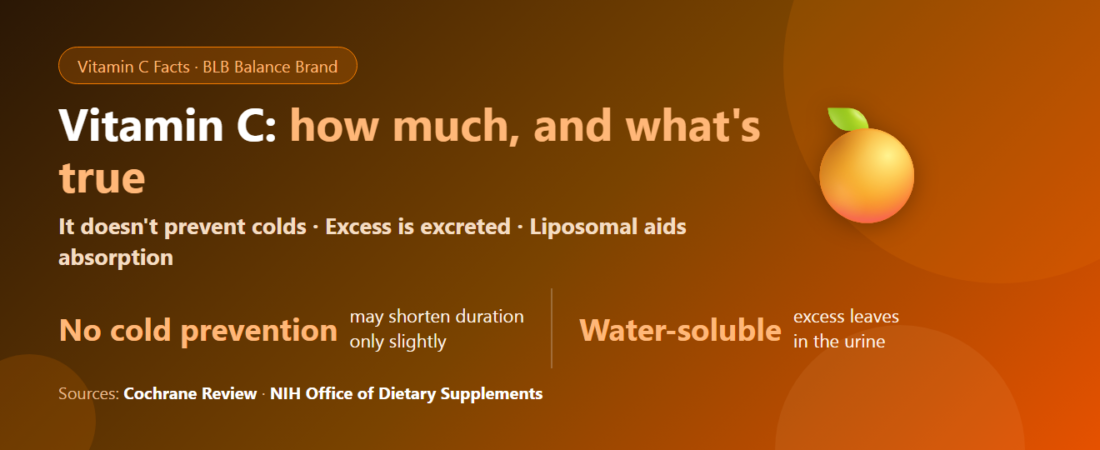
At the first sign of a sore throat, many people reach for vitamin C, convinced it “prevents colds” · But the actual research says something rather different · So how much vitamin C do you really need, is more genuinely better, and how does the pricier “Liposomal Vitamin C” differ from ordinary vitamin C? · This article answers it all based on evidence, not advertising
duration (slightly)
in the urine
gentler on the stomach
Vitamin C (ascorbic acid) is a water-soluble vitamin that plays an important role in the immune system and collagen formation, and acts as an antioxidant · The body cannot make it, so it must come from food or supplements · Yet many popular beliefs about vitamin C do not match what the research actually shows
1 The truth about “vitamin C prevents colds”
- For the general population, vitamin C does not “prevent” catching a cold — large studies have found that taking vitamin C regularly does not reduce the chance of getting a cold in the general population
- It may help slightly with “duration” — some studies found it may shorten the duration of cold symptoms a little if taken consistently
- People who exercise very intensely or are exposed to extreme cold may see different benefits from the general population
In short: vitamin C is useful for immune function, but it is not a “cold-prevention drug” as many people assume · Sleep, diet and hygiene still matter more for staying well
2 How much vitamin C is enough — and what counts as too much
- The daily requirement for adults sits in the range of “tens of milligrams”, which fruit and vegetables alone can supply for most people
- Vitamin C is water-soluble — take more than you need and the body excretes it in the urine; the extra does not accumulate as extra benefit
- Taking very high doses routinely may cause diarrhoea and stomach irritation, and in some people raises the risk of kidney stones · More is not necessarily better
3 How Liposomal Vitamin C differs from the ordinary kind
Ordinary high-dose vitamin C has its limits — the body can only absorb so much per dose and high doses may irritate the stomach · Liposomal technology wraps vitamin C in a fat layer similar to a cell membrane, which:
| Aspect | Ordinary vitamin C | Liposomal |
|---|---|---|
| Absorption | Limited per dose, especially at high doses | Designed to aid absorption |
| Stomach irritation | High doses may irritate | Usually gentler on the stomach |
| Price | Cheaper | Higher |
Liposomal is an option for people who want vitamin C that absorbs well and sits comfortably in the stomach · But it does not mean you always have to take a high dose — a sensible amount still matters
💡 Did you know? Ordinary high-dose vitamin C is often absorbed only to a limited degree and may irritate the stomach · Lipo C from BLB is a Liposomal vitamin C combined with Zinc, designed to aid absorption and be gentle on the stomach — suited to people who want to look after their immunity and skin · Thai FDA 26-1-10867-5-0046 · This is a dietary supplement, not a medicine, not a cold-prevention drug, and it has no disease-treatment effect
4 Get your vitamin C from food first
- Fruit — guava, orange, papaya, kiwi, strawberry
- Vegetables — bell pepper, broccoli, kale, tomato
- Eat them raw or cook briefly — vitamin C degrades with heat and time
- Supplements — a help when food alone is not enough, or during periods when you need extra care
5 Frequently Asked Questions (FAQ)
Does vitamin C really prevent colds?
For the general population, it does not prevent catching a cold · It may slightly shorten how long symptoms last if taken consistently · It is not a cold-prevention drug; overall health care matters more
Is taking lots of vitamin C a good idea?
No · Vitamin C is water-soluble, so the body excretes the excess · Very high doses taken routinely may cause diarrhoea and raise kidney-stone risk in some people · A sensible amount is best
Is Liposomal Vitamin C worth it?
It suits people who want vitamin C that absorbs well and is easier on the stomach than ordinary high doses · But if you already get enough vitamin C from food, a high dose may not be necessary
When is the best time to take vitamin C?
It can be taken on an empty stomach or with food · Some people absorb it better on an empty stomach, while others find it irritating · If it irritates, take it with food · Consistency is what matters
Does vitamin C help the skin?
Vitamin C plays a role in collagen formation and acts as an antioxidant, both of which relate to skin health · But it is one part of overall care, not a magic result from supplementing alone
Who should be cautious with high-dose vitamin C?
People with a history of kidney stones, kidney disease, iron overload, or who take regular medication should consult a doctor first
6 Precautions
- People with a history of kidney stones, kidney disease or iron overload should consult a doctor before taking high doses
- Vitamin C is not a cold-prevention drug or a medicine for treating disease
- Taking very high doses routinely may cause diarrhoea or stomach irritation — a sensible amount is better
- Dietary supplements are not medicines; they have no effect in preventing, alleviating or treating disease, and are only an aid to looking after your health
- Pregnant or breastfeeding women should consult a doctor about an appropriate dose
7 Summary
- Vitamin C matters for immunity and collagen, and acts as an antioxidant
- It does not “prevent” colds in the general population — it may help slightly with duration
- It is water-soluble, and the excess is excreted — more is not better
- Liposomal aids absorption and is easier on the stomach, an option for those who want it
Vitamin C is an important nutrient you should get enough of — but it is not a magic cure · Understand it as it really is, choose the amount and the form that suit you, and get it mainly from food, and you will look after your health well without spending more than you need to
References
- Hemilä H, Chalker E. Vitamin C for preventing and treating the common cold. Cochrane Database Syst Rev.
- NIH Office of Dietary Supplements — Vitamin C Fact Sheet.
- Lykkesfeldt J, Tveden-Nyborg P. The Pharmacokinetics of Vitamin C. Nutrients.
- Carr AC, Maggini S. Vitamin C and Immune Function. Nutrients.
💡 Looking for something to help? Read next: Which vitamin C brand is good — choosing wisely 👉