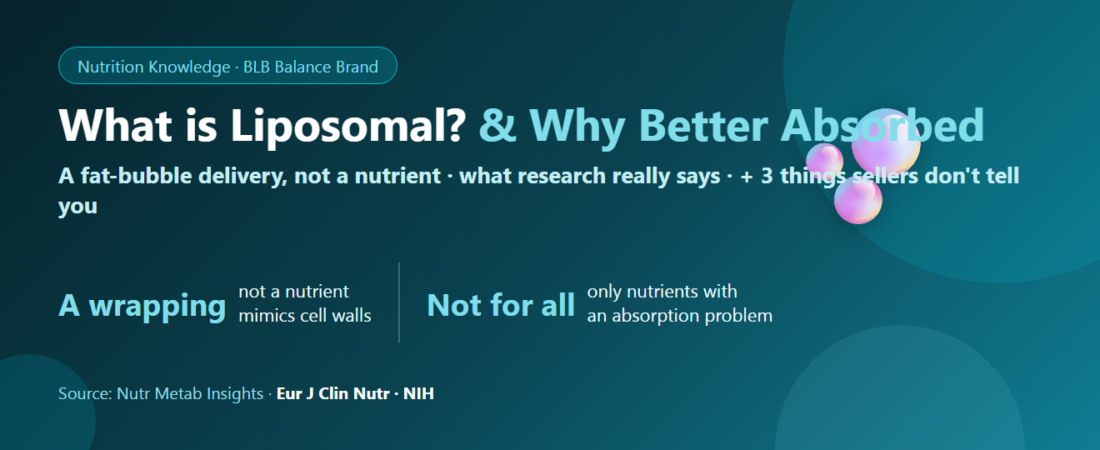
Every supplement shelf these days is covered in the word “Liposomal” — and it usually costs noticeably more than the regular version. So what actually is it? Is it really different, or just marketing? This article explains it plainly, including the limitations most sellers don’t talk about.
our own cell walls
this technology
equally strong for all
Liposomal is not the name of a nutrient — it’s a “way of wrapping” a nutrient, encasing it in a tiny fat bubble whose structure resembles our body’s own cell membranes. It solves the problem that some nutrients absorb poorly when swallowed. This article covers everything worth knowing — what it is, how it works, what research really says, and when it isn’t necessary.
1 What is a liposome — explained visually
Picture a soap bubble, but one made of fat — a liposome is an extremely tiny spherical sac (thousands of times smaller than a hair) whose wall is made of phospholipids arranged in a double layer — the same structure as the cell walls in our body.
- Inside the sac — the nutrient you want to deliver (e.g. vitamin C, glutathione, magnesium)
- The wall — a double fat layer, just like a cell membrane
- Why it matters — because a wall that “looks the same” passes through the digestive tract more easily and merges with cells more readily
In short: instead of dropping a bare nutrient into the stomach to be digested, we put it in a tiny capsule the body is familiar with.
2 Why some nutrients need help
| Problem | Which nutrients |
|---|---|
| Broken down before absorption | Glutathione — a peptide that is largely digested in the gut |
| Irritates the stomach at high doses | Vitamin C · Zinc — high amounts cause stomach pain, nausea, loose stools |
| Limited absorption per dose | Vitamin C — the body has limited transporters; excess is excreted |
| Draws water into the gut → loose stools | Some forms of magnesium |
| Fat-soluble but taken on an empty stomach | Vitamin D · K2 — need fat to be carried |
Notice the problems differ — so liposomal helps to different degrees for different nutrients, depending on what the original problem was.
3 ⚠️ 3 truths most sellers don’t tell you
Truth 1 — the evidence isn’t equally strong for every nutrient: research on liposomal is real and meaningful for some nutrients — for example, liposomal vitamin C has studies showing higher blood levels than the regular form at the same dose, and liposomal glutathione has research showing it raises the body’s glutathione stores. But some nutrients still have little data. Assuming “liposomal is always better for everything” is incorrect.
Truth 2 — not every nutrient needs it: for nutrients the body already absorbs well, making them liposomal adds little benefit — it’s useful for nutrients that genuinely have an absorption or irritation problem. If you see a product making everything liposomal for no reason, be skeptical.
Truth 3 — the word “Liposomal” on a label is not a quality guarantee: the term has no enforced central standard — anyone can write it. Real quality depends on the manufacturing process, the type of phospholipid, and the stability of the sacs — none of which you can tell from the label. Always also look at the manufacturer, the FDA registration number, and the brand’s credibility.
⚠️ Note: dietary supplements are a “support” for health, not medicine; they do not prevent, treat, or cure disease. Liposomal is only a delivery form — it does not turn a supplement into a drug.
4 BLB’s Lipo Series — 5 products, each used differently
Each one uses liposomal for a different reason, based on that nutrient’s problem:
| Product | Main nutrient | Why liposomal | FDA reg. |
|---|---|---|---|
| Lipo Mg | Magnesium (3 forms) | reduces the loose-stool issue seen with some magnesium forms | 26-1-10867-5-0047 |
| Lipo C | Vitamin C + Zinc | vitamin C has limited absorption per dose + high amounts irritate the stomach | 26-1-10867-5-0046 |
| Lipo Zn | Zinc + L-cysteine | high-dose zinc can cause nausea | 26-1-10867-5-0059 |
| Lipo D3 | D3 + K2 + Magnesium | D3/K2 are fat-soluble — the fat sac carries them directly | 26-1-10867-5-0048 |
| Lipo Gluta | Glutathione | the one that needs it most — because it’s digested before absorption | 26-1-10867-5-0043 |
💡 Read more on each: Magnesium timing · Liposomal vitamin C · Zinc for skin & hair · Vitamin D3 & K2 · Liposomal glutathione vs tablets
5 Frequently Asked Questions (FAQ)
What is a liposome, and how is it different from “liposomal”?
A liposome is a particle that wraps an active ingredient in a fat (phospholipid) layer resembling a cell membrane. “Liposomal” means it’s in liposome form — protecting the ingredient from stomach acid and improving absorption compared with the regular form.
Is liposomal a new kind of nutrient?
No. Liposomal is not the name of an ingredient — it’s a way of wrapping a nutrient in tiny fat sacs that resemble cell walls. The nutrient inside is still the same vitamin or mineral.
Is liposomal always better than the regular form?
Not always. It benefits nutrients that genuinely have an absorption or irritation problem. If a nutrient already absorbs well, making it liposomal adds little, and the research isn’t equally strong for every nutrient.
Why is liposomal more expensive?
Because the manufacturing is more complex, requiring quality phospholipids and specific techniques to make stable sacs. But expensive doesn’t always mean better — also check the manufacturer and FDA registration.
How much can you trust the word “Liposomal” on a label?
The term has no enforced central standard — anyone can write it. Real quality depends on the manufacturing process, which you can’t see from the label. Always also check the FDA registration number, the manufacturer, and the brand’s credibility.
When should I take it?
It depends on the nutrient inside — e.g. magnesium is popular before bed, while vitamin C, zinc, D3 and glutathione are often recommended in the morning on an empty stomach. Follow the directions on each product’s label.
Does liposomal turn a supplement into a drug?
No. Liposomal is only a delivery form. A dietary supplement is still not a medicine and does not prevent, treat, or cure disease.
6 Comparison — Liposomal vs regular
| Aspect | Regular | Liposomal |
|---|---|---|
| Absorption | depends on the nutrient; some are digested/limited | research shows better for some (e.g. vit C, glutathione) |
| Stomach irritation | high doses often irritate | usually gentler |
| Price | cheaper | more expensive (complex to make) |
| Best for | nutrients that already absorb well | nutrients with absorption/irritation problems |
| Trustworthiness of the label word | — | no central standard — check FDA reg./maker too |
7 Precautions
- “Liposomal” is not a quality guarantee — the term has no enforced central standard; always check the FDA registration and manufacturer too.
- Better delivery doesn’t mean you can take more — still follow the label dose; better absorption doesn’t make overdosing safer.
- People allergic to soy or phospholipid components should read the label carefully, as liposomes are often made from lecitin that may come from soy.
- Dietary supplements are not medicine — they do not prevent, treat, or cure disease. Liposomal doesn’t change this.
- Pregnant/breastfeeding women or those on regular medication should consult a doctor first.
8 Summary
- Liposomal isn’t a nutrient — it’s a wrapping method: a double fat layer mimicking a cell membrane.
- It solves specific problems — nutrients digested before absorption, or that irritate the stomach at high doses.
- Not every nutrient needs it, and the evidence isn’t equally strong for all.
- The label word has no central standard — always check the FDA registration and manufacturer.
Liposomal is a genuinely evidence-backed technology, not just a buzzword — but it’s not a magic word that automatically makes everything better. Understand what problem it solves, and use it for the nutrients it truly helps — that’s the most worthwhile approach.
References
- Davis JL, et al. Liposomal-encapsulated Ascorbic Acid: Influence on Vitamin C Bioavailability. Nutr Metab Insights.
- Sinha R, et al. Oral supplementation with liposomal glutathione elevates body stores of glutathione. Eur J Clin Nutr.
- Akbarzadeh A, et al. Liposome: classification, preparation, and applications. Nanoscale Res Lett.
- NIH Office of Dietary Supplements — Vitamin C / Magnesium / Zinc Fact Sheets.